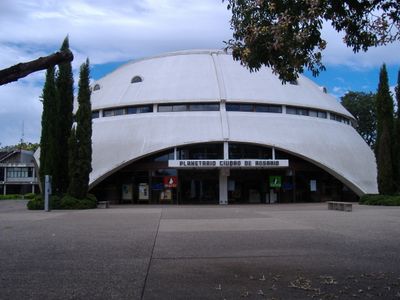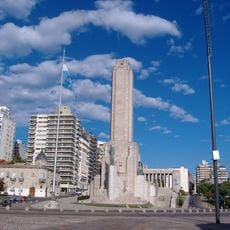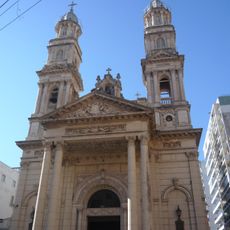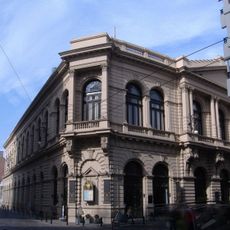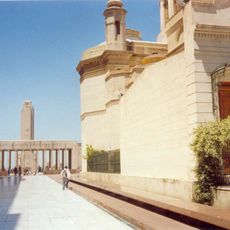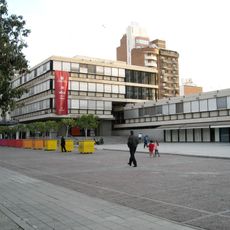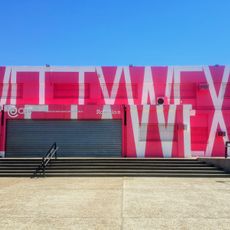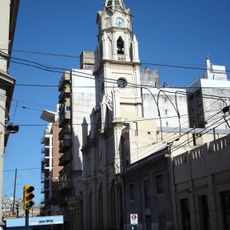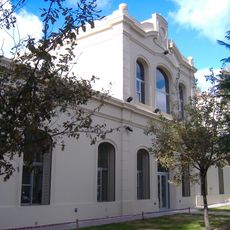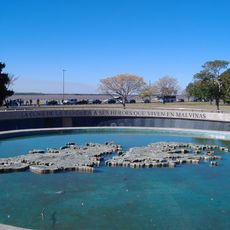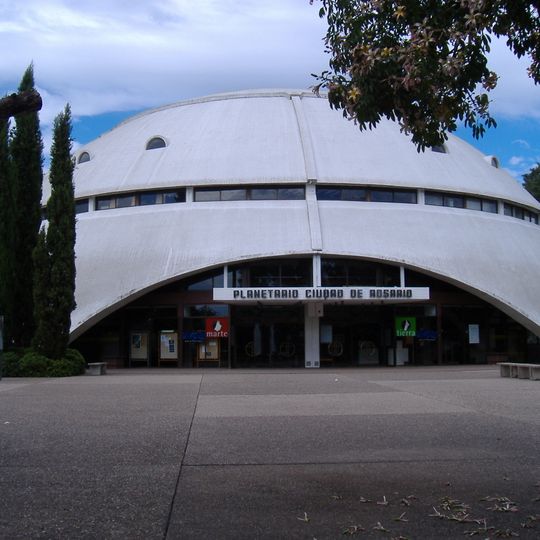
Planetarium of Rosario, Municipal astronomical observatory in Urquiza Park, Rosario, Argentina.
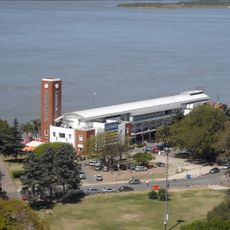
The Professor Victorio Capolongo Astronomical Observatory occupies the second floor of the observatory building in the Urquiza Park complex, whose central building is shaped like a comet. Its 4.20 m dome houses two Carl Zeiss instruments: a Coudé refractor with a 2250 mm focal length and 150 mm aperture, fitted with a monochromatic Lyot filter for solar observation, and a 300 mm Cassegrain reflector.
The Complejo Astronómico Municipal, which includes the observatory, was officially inaugurated on 18 June 1970 in the southwest sector of Urquiza Park, at Diario La Capital 1602 near Chacabuco street. It is run by the Secretaría de Cultura y Educación of the Rosario municipality. The planetarium named after Luis Cándido Carballo was added on 19 June 1984.
The facility teaches people about astronomy through regular sky observation sessions and scientific demonstrations that draw school groups and community visitors. It plays an important role in science education for the local public.
Sky observation takes place in the main dome on the second floor of the observatory building, Monday to Friday from 8:30 PM to 10:00 PM, and only with a clear sky; entry is free. The dome holds two Carl Zeiss telescopes, a 150 mm refractor with a Lyot filter for the Sun and a 300 mm Cassegrain reflector.
The complex includes an Experimental Science Museum that opened in 1987 as the country's first interactive science museum. Visitors can explore hands-on exhibits covering different fields of science.
The community of curious travelers
AroundUs brings together thousands of curated places, local tips, and hidden gems, enriched daily by 93,878 contributors worldwide.