Hancock Park, Urban park with tar pits in Miracle Mile, Los Angeles, US.
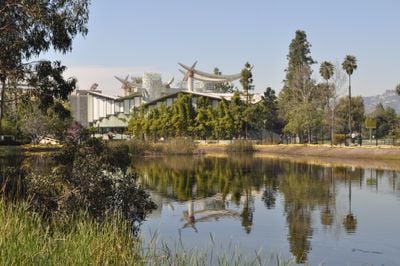
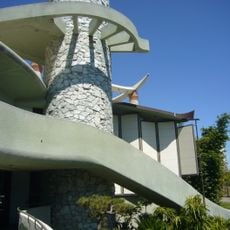
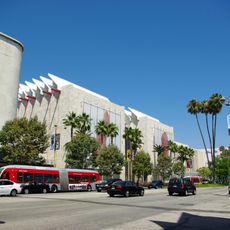
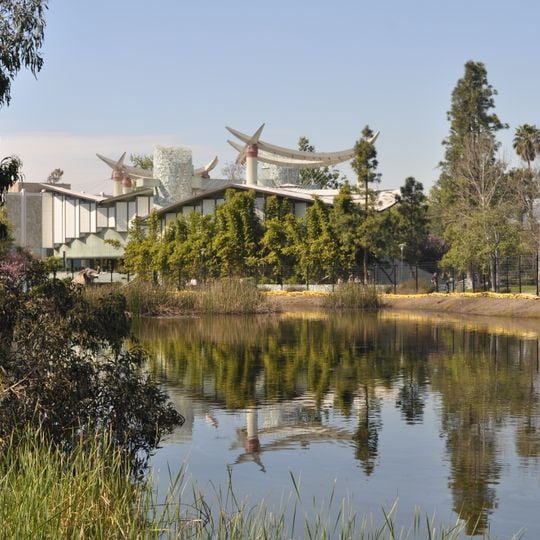
Hancock Park is a city park in the Miracle Mile section of Los Angeles, home to the La Brea Tar Pits, the George C. Page Museum and the Los Angeles County Museum of Art. The photograph shows a low pale gray concrete building with angled vertical fins across its lower level and dark window bands behind them. Two pairs of curved white wing-like structures on rust-red columns are mounted above the roofline at opposite ends, with a mottled gray tower between them. Trees and a reflecting pool stand in front.
George Allan Hancock discovered the fossil deposits in 1883 while drilling for oil and later transferred the land to the public so the finds could be protected. Excavations began officially in the early 20th century and have since brought millions of bone pieces to light.
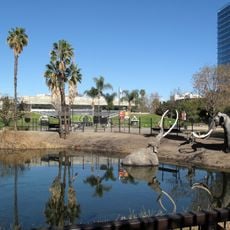
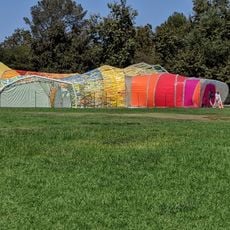
Visitors today see glass pavilions where researchers work daily on bones recovered from the black tar. Many school groups come here to understand how animals long ago became trapped in the sticky pits and could not escape.
The entire area is flat and easy to walk, with benches along the paths for short breaks. Mornings and late afternoons tend to be calmer, while midday often sees groups passing through.
The park's Pleistocene Garden was planted from a list compiled during 35 years of research at the Pit 91 excavation. It groups plants into four ecoregions — coastal sage scrub, riparian, deep canyon California oak woodlands and California montane chaparral — to show the Los Angeles Basin's vegetation of 10,000 to 40,000 years ago.
The community of curious travelers
AroundUs brings together thousands of curated places, local tips, and hidden gems, enriched daily by 92,631 contributors worldwide.