Big Bear Solar Observatory, Solar observatory in Big Bear Lake, California, United States.
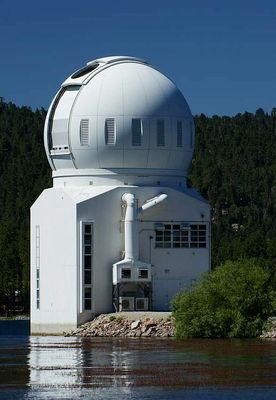
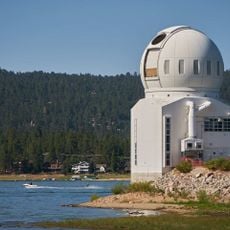
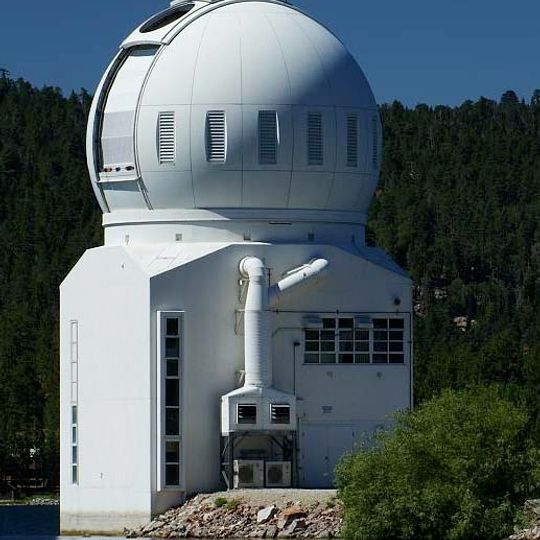
The Big Bear Solar Observatory is a white building with a rectangular base topped by a large spherical dome, standing on exposed rock and soil in the open water of Big Bear Lake, reached by a causeway about 200 meters long from the north shore. The dome has a vertical opening on its left side and vents on its upper section; a tall window sits on the left of the base, and a white external duct with two elbows runs down to a ground-level unit.
Founded in 1969 by the California Institute of Technology and later transferred to the New Jersey Institute of Technology in 1997, the observatory became operational with its New Solar Telescope achieving first light in January 2009.
The observatory hosts a station of the Global Oscillation Network Group, a helioseismology experiment run by the National Solar Observatory, at the shore end of the causeway since 1995. Its name comes from Big Bear Lake, and the site is listed in the observatory code list as G77, Baldwin Lake.
The main building sits in the open water of Big Bear Lake, reached by a causeway about 200 metres long from the north shore. The Global Oscillation Network Group station stands at the shore end of that causeway. The site lies at roughly 2,055 metres above sea level, about 120 kilometres east of downtown Los Angeles.
The main building sits in the open water of Big Bear Lake, reached by a causeway about 200 metres long from the north shore. The lake water to the west, more than a mile of it, cools the air the prevailing winds carry over the telescope and reduces ground-layer turbulence.
The community of curious travelers
AroundUs brings together thousands of curated places, local tips, and hidden gems, enriched daily by 94,102 contributors worldwide.