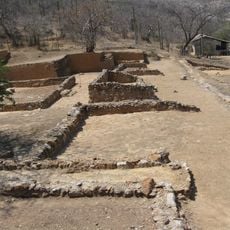
Juxtlahuaca, Cave archaeological site in Guerrero, Mexico.
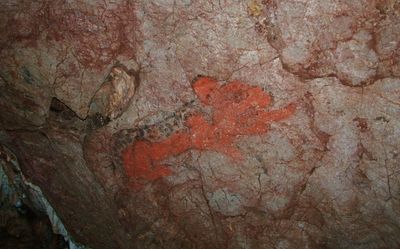
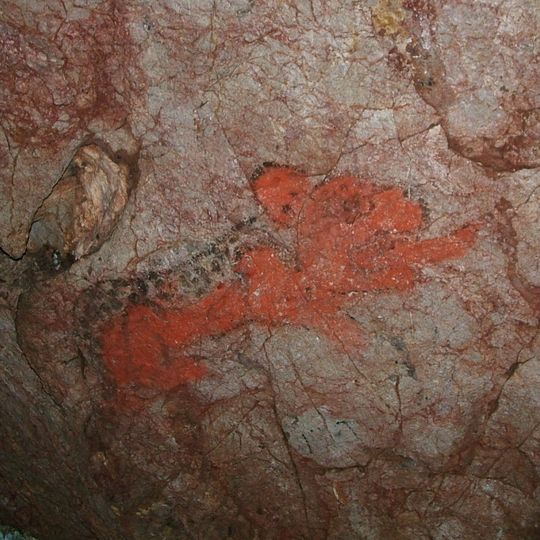
Juxtlahuaca is a cave system in Guerrero, Mexico, with passages over 5 km long. Its best-known painting, Painting 1, is a 2-meter-tall figure with a black cloak, jaguar-fur limbs, a trident and a snake-like object, facing a smaller crouched figure. The red paint of the figure lies on rough, cracked grey, brown and pinkish stone.
The paintings were known locally by the 1920s, but the first professional documentation came in the early 1960s from Gillett Griffin of Princeton University and Italian businessman Carlo T. E. Gay. Archaeologist Michael D. Coe later estimated their date as Early Preclassic, around 1200–900 BC. In 1958 the Guerrero state government had ordered a first exploration of the galleries, led by Andrés Ortega Casarrubias.
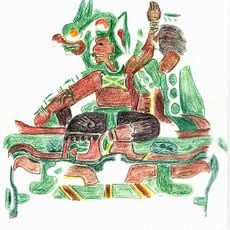
Painting 1 shows a bearded man in a black cloak, striped tunic and jaguar-fur limbs, holding a trident and a snake-like object toward a smaller crouched figure. Nearby are a red Feathered Serpent with green plumes and a red jaguar with large ears and eyes. Some researchers read the scene as human sacrifice.
Access is only with a local guide, and the gallery lies about 1,300 m from the surface, reached by up to two hours of walking through passages that are partly flooded where water seeps in. The Achakalli cave is closed to visitors for safety. The full 5 km system takes about 72 hours to traverse, so most visits cover only the painted gallery.
Just before the paintings, a 250-foot (80 m) canal was cut into the cave's red clay floor; its purpose remains unknown. Midway between the entrance and the paintings lies the Hall of the Dead, where a dozen skeletons, some extended and some fetal, were found encrusted with stalactite and partly buried by a cave-in.
The community of curious travelers
AroundUs brings together thousands of curated places, local tips, and hidden gems, enriched daily by 94,055 contributors worldwide.