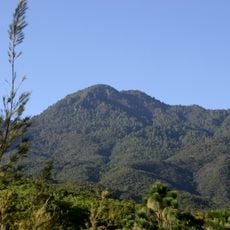
Chevé Cave, Cave system in Sierra Juárez mountains, Mexico.
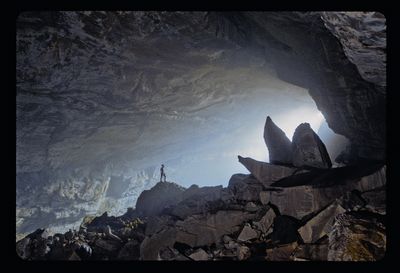
Chevé Cave is a cave system in the Sierra Juárez of Oaxaca, with more than 89 km of mapped passages and a proven depth of 1,529 m. Its main entrance leads to a large breakdown pile reached after two sumps, and the cave's roof forms a dark, banded mass above floors of angular grey boulders. A small figure can be seen on a rounded outcrop in the main chamber.
Bill Farr and Carol Vesely found Chevé in the mid-1980s. Exploration under Bill Stone pushed it to 1,529 m deep by 2023, with 89 km of passages mapped. In 1988 Janet Fitzsimmons and INAH recorded a turquoise mosaic tablet in Chamber 1, dated 1250–1500 AD, and in 2004 a team discovered the nearby J2 entrance.
Cuicatec beliefs centre on the Señor del Cerro, a figure said to dwell in Chevé and cure souls. The 1988 Cheve Archaeological Project, led by Janet Fitzsimmons with INAH Oaxaca, recorded jade beads, a wooden mask, in-situ vessels, buried human remains and obsidian blades used in bloodletting. Its main find, the Cueva Cheve Tablet, a turquoise mosaic dated 1250–1500 AD, shows a battle scene with winners and losers.
Reaching the present limit of exploration, 11.77 km from the nearest entrance, requires rigging more than two kilometres of rope and establishing seven underground camps. Cave temperatures stay between 8 and 11 °C, so cavers need insulation and long expedition logistics. Expeditions are now searching for mid-way entrances to shorten the route into the middle system.
In 1988 the Cheve Archaeological Project, led by Janet Fitzsimmons with INAH Oaxaca, found a turquoise mosaic tablet in Chamber 1, dated to the Late Postclassic (1250–1500 AD); one quadrant shows a battle scene with winners and losers. Jade beads, a wooden mask and obsidian blades were also recorded.
The community of curious travelers
AroundUs brings together thousands of curated places, local tips, and hidden gems, enriched daily by 93,762 contributors worldwide.