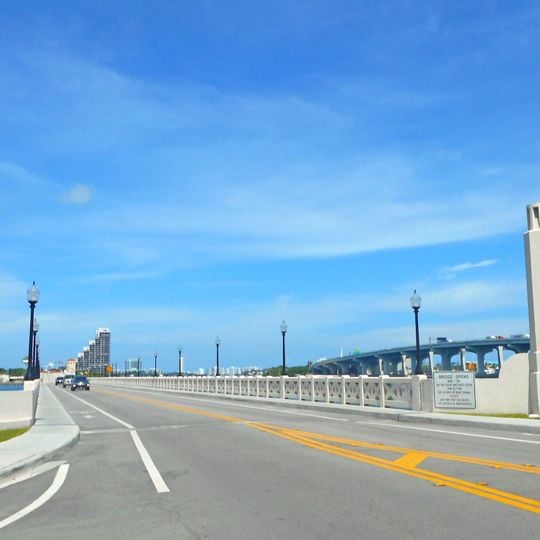
Venetian Causeway, Historic bridge connecting Miami to Miami Beach, United States
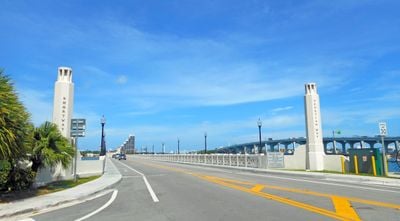
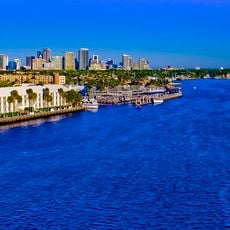
The Venetian Causeway is a bridge spanning Biscayne Bay that connects Miami to Miami Beach and stretches across several kilometers. The crossing consists of multiple concrete spans with two movable bridge sections for ships and passes over artificial islands that formed during construction.
The Venetian Causeway follows the route of the Collins Bridge, a wooden structure 2.5 mi (4 km) long built in 1913 by John S. Collins and Carl G. Fisher, which opened the barrier island to rapid growth. The causeway was listed in the National Register of Historic Places in 1989 and re-dedicated in 1999 after a $29 million restoration and replacement project. In 2023 Miami-Dade County began planning to replace the 11 original bridges with higher structures.
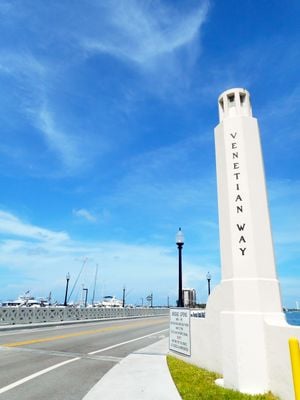
The name comes from the Venetian Islands, the chain of dredged islands the roadway crosses; the causeway follows the route of the 1913 Collins Bridge, a wooden structure built by John S. Collins and Carl G. Fisher. At the downtown end, two columns lettered "VENETIAN WAY" greet drivers. The causeway is popular with joggers and cyclists, and the racehorse Venetian Way, winner of the 1960 Kentucky Derby, was named after it.
A toll plaza on Biscayne Island, the westernmost Venetian Island, charges cars US$3.00. Two bascule bridges open for boats; signs at the approaches list the daily opening times and ask drivers to stay 100 ft back from the drawbridge. Jogging and bicycling are common uses of the causeway.
The bridge connects six artificial islands that formed from dredged material taken directly from the bay during construction. These islands are now densely settled and provide quiet residential areas with water views.
The community of curious travelers
AroundUs brings together thousands of curated places, local tips, and hidden gems, enriched daily by 92,592 contributors worldwide.