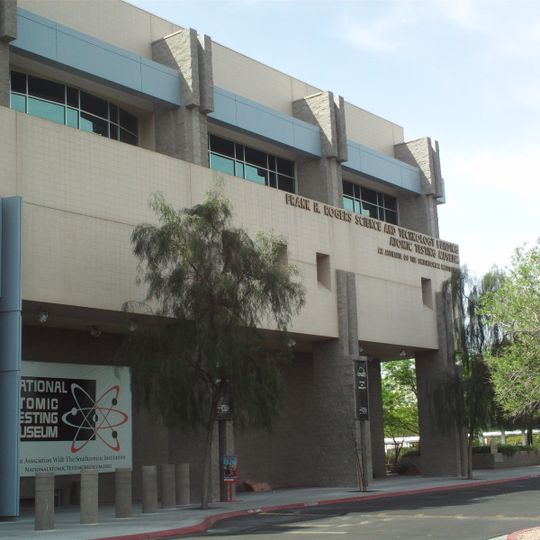
National Atomic Testing Museum, Military museum in Las Vegas, United States.
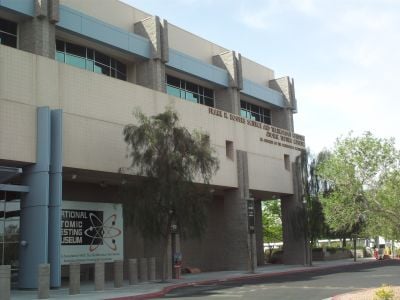
The National Atomic Testing Museum occupies a tan, blocky building at 755 E. Flamingo Rd., east of the Las Vegas Strip and adjacent to the UNLV campus. Raised lettering on the facade names it and notes its affiliation with the Smithsonian Institution. Inside, exhibits run from the first Nevada Test Site detonation on January 27, 1951, to the present, with Geiger counters, radiation badges, test equipment, a Ground Zero Theater and a piece of the Berlin Wall.
The museum opened in March 2005 as the Atomic Testing Museum, run by the Nevada Test Site Historical Foundation as a 501(c)(3) non-profit, with funding partly from sales of commemorative Nevada Test Site license plates. Its exhibits cover the period from the first test at the Nevada Test Site on January 27, 1951, to the present. On December 31, 2011, President Barack Obama signed a military spending bill designating it a national museum affiliated with the Smithsonian Institution, one of 37 such museums in the United States.
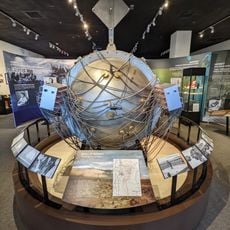
The museum's Ground Zero Theater reproduces the flash, roar and blast wind of an atmospheric nuclear test, a format drawn from the era when tests were watched from trenches at the Nevada Test Site. Nearby cases hold Geiger counters, radiation badges and testing devices, alongside atomic-age pop culture memorabilia and Native American artifacts collected around the test area.
The museum stands at 755 E. Flamingo Rd., just north of Harry Reid International Airport and east of the Las Vegas Strip, next to the UNLV campus. The Ground Zero Theater simulates an atmospheric test with flash, sound and wind, so allow time for it within a visit. A weather station outside records temperature, wind speed and background gamma radiation for downtown Las Vegas.
The weather station outside the museum is part of the Community Environmental Monitoring Network (CEMP) and records temperature, wind speed and background gamma radiation in microroentgens per hour for downtown Las Vegas. It is one of the network's public monitoring points, so the readings are not limited to the museum grounds.
The community of curious travelers
AroundUs brings together thousands of curated places, local tips, and hidden gems, enriched daily by 93,126 contributors worldwide.