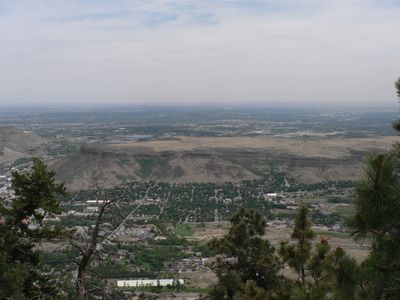
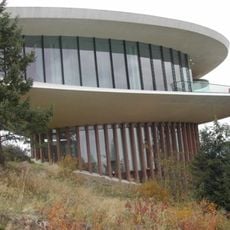
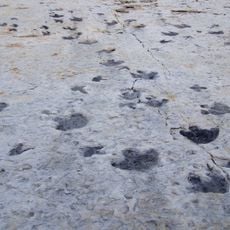
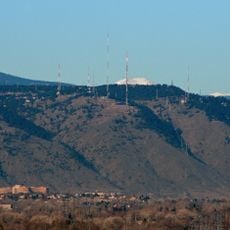
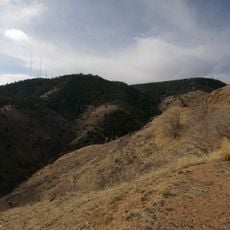
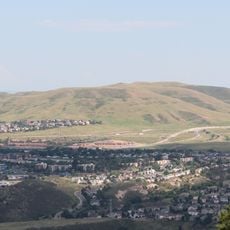
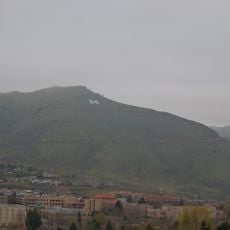
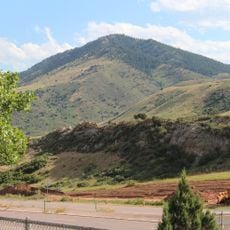
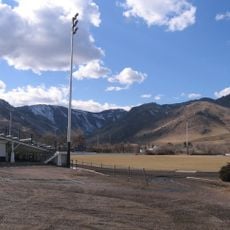
South Table Mountain, Mesa summit in Golden, Colorado.
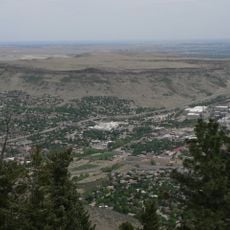
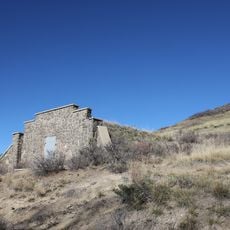
South Table Mountain is a mesa on the eastern flank of the Front Range, rising directly east of downtown Golden, Colorado. Its nearly flat cap is formed by two columnar-jointed lava flows about 62 to 64 million years old, classified as latite or shoshonite. Castle Rock, a small butte at the northwest end, is the 6,338-foot summit and stands on private property.
The first recorded ascent was on February 14, 1859, by Thomas L. Golden and other gold rushers hunting during the Colorado Gold Rush. In 1906 William H. and Clyde L. Ashworth built the Castle Rock Resort cafe atop Castle Rock, reached by burro trail. A lighthouse, dance hall and funicular railway followed in 1913; the resort burned in 1927.
The name Table Mountain comes from the flat cap visible from Golden. Castle Rock, the butte at the northwest end, was first called Table Rock. Archaeological remains left by American Indian tribes are known on the mesa top, and a piece of grape shot, possibly from Spanish explorers or 1830s fur traders, was found there by Arthur Lakes in April 1895.
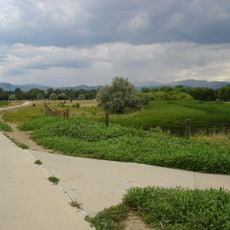
Most of the mesa is Jefferson County Open Space, but Castle Rock and the summit lie on private property and cannot be entered. Trails climb from trailheads around Golden to the open plateau. The mesa is known among locals for a dense rattlesnake population, so watch the path, and carry water and sun protection on the exposed top.
The volcanic rock on South Table Mountain contains zeolite minerals, which formed as crystals inside small cavities within the cooling lava. Some of these mineral samples are on display in local museums in Golden, giving visitors a closer look at what lies beneath the surface of the mesa.
The community of curious travelers
AroundUs brings together thousands of curated places, local tips, and hidden gems, enriched daily by 94,524 contributors worldwide.