Jaflong, Hill station at Bangladesh-India border, Bangladesh
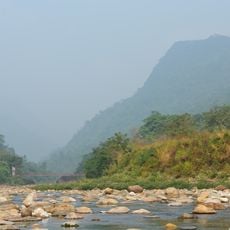
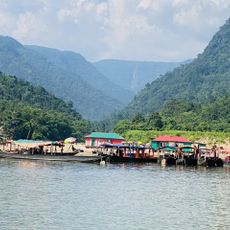
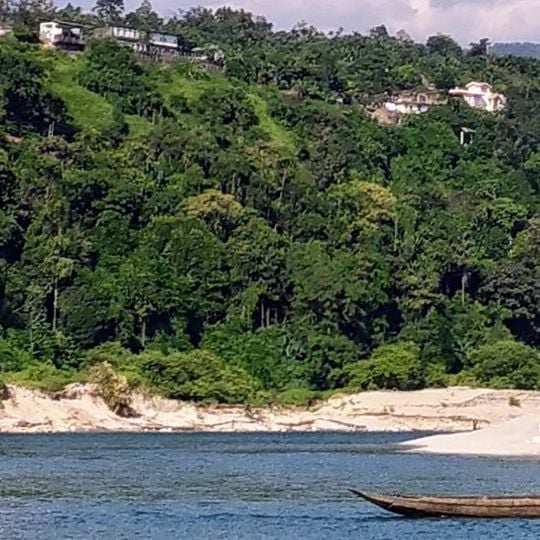
Jaflong is a tourist spot in Gowainghat Upazila, Sylhet District, on the Bangladesh-India border. The Dawki River enters Bangladesh here, and the Piyain River flows over a bed of rounded stones and boulders in grey, tan, brown and reddish tones. A steep, tree-covered hill with a few light-walled, dark-roofed buildings rises above the water.
The region developed as a settlement area for the Khasi people, who established themselves over time through farming and trade. Their presence shaped the valley and its connection to neighboring Meghalaya across the border.
Five Khasi punjis — Balla, Sangrampunji, Nokshiapunji, Lamapunji and Pratap Pur — lie within Jaflong, home to 1,953 Khasi people by census. The Khasi cultivate betel leaf and areca nut in gardens around the villages. On Pohela Boishakh, the Bengali New Year, a Baishakhi fair fills the area with festivities.
Jaflong lies about 56 km by road from Sylhet Sadar, a route opened in the 1980s; the English Wikipedia gives roughly 60 km and a two-hour drive. At Jaflong Zero Point stands the Tamabil land port, through which goods, coal from India in particular, cross daily. The Dawki river's flow swells with monsoon rain on the Indian side, so the shallows and boulder bed change with the season.
The Dawki River carries large boulders down from the Shillong plateau during heavy monsoon rain, which is why Jaflong's riverbed holds so much stone. Extraction has cut 30–35-foot pits without approval, and in May 2009 a flash flood from upstream damaged tea gardens and a settlement here.
The community of curious travelers
AroundUs brings together thousands of curated places, local tips, and hidden gems, enriched daily by 94,355 contributors worldwide.