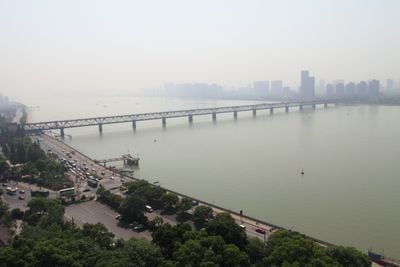
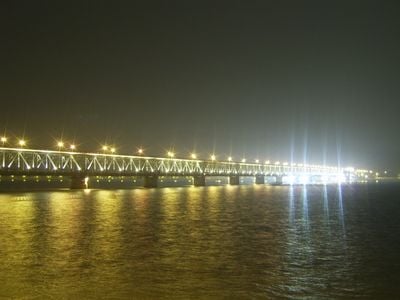
Qiantang River Bridge, Double-decker transport bridge in Hangzhou, China.
The Qiantang River Bridge is a double-decker structure spanning about 1,072 meters across the waterway with 16 truss sections supporting the load. The upper level carries road traffic while the lower level accommodates trains, making it a combined road-rail crossing.
The bridge was designed by engineer Mao Yisheng and opened on 29 September 1937, representing an early achievement in complex infrastructure for China. During wartime, the structure survived an intended demolition when military forces controlled the area.
The structure became a symbol of China's engineering progress in the 20th century and remains part of Hangzhou's identity as a modern transport hub. Locals and visitors can see how the dual-level design solved the practical challenge of moving both cars and trains across the same waterway.
The bridge is accessible via road and rail connections, and visitors can cross on foot or by vehicle to observe the structure up close. Since it remains an active transport route, be aware of traffic conditions and follow designated pedestrian areas.
The structure was built by Dorman Long engineers using specialized techniques to withstand the powerful tidal bores that surge through the Qiantang River. This construction approach allowed the bridge to resist extreme water forces that would have damaged other structures.
The community of curious travelers
AroundUs brings together thousands of curated places, local tips, and hidden gems, enriched daily by 91,059 contributors worldwide.