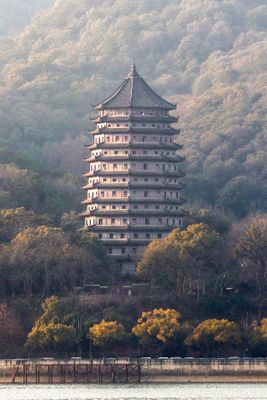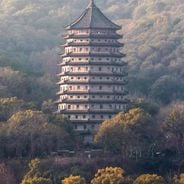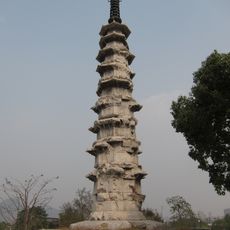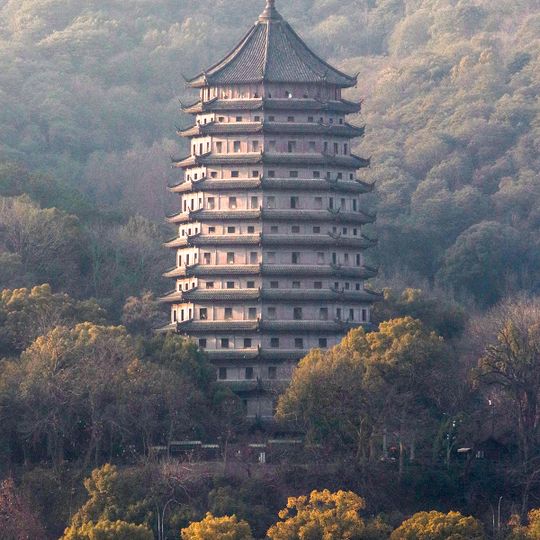
Liuhe Pagoda, Pagoda at Yuelun Hill, Hangzhou, China
Liuhe Pagoda is a brick-and-wood octagonal tower on the south slope of Yuelun Hill, 59.89 metres tall, with thirteen exterior eaves but only seven interior storeys. Its pale walls carry 174 groups of brick carvings of flowers, birds, beasts and musicians, and each storey has a plaque, from "Chudi Jiangu" on the first to "Qibao Zhuangyan" on the seventh. A 3.55-metre iron finial tops the roof.
The tower was first built in 970 during the Wuyue Kingdom and later completely reconstructed in 1165 after being destroyed in 1121. This major rebuilding shaped the structure you see today.
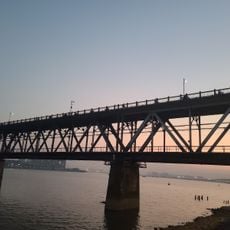
The name Liuhe refers to the six Buddhist ordinances, and the pagoda was built to calm the Qiantang River tidal bore. Each of the seven interior ceilings carries carved and painted animals, flowers, birds and characters. Plaques name the floors, from "Chudi Jianggu" on the first to "Qibao Zhuangyan" on the seventh. In Water Margin, the monk Lu Zhishen hears the tidal roar here and dies in seated meditation.
You can reach all seven interior floors via an internal spiral staircase with sections and chambers on each level. Wearing comfortable shoes is useful since the steps are steep and narrow.
The pagoda served as a permanent lighthouse on the Qiantang River from near its beginning, guiding sailors to anchorage at night, as recorded in the Hangzhou Fu Zhi and noted by Joseph Needham. The iron finial at the top stands 3.55 metres tall.
The community of curious travelers
AroundUs brings together thousands of curated places, local tips, and hidden gems, enriched daily by 94,055 contributors worldwide.