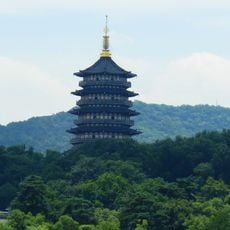
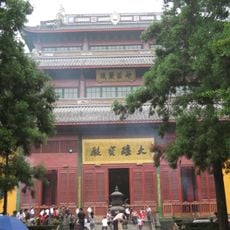
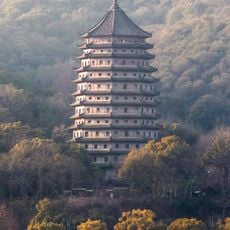
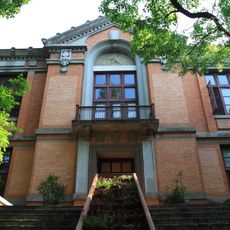
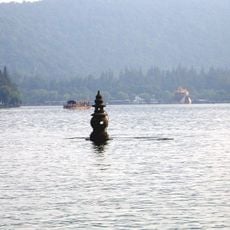
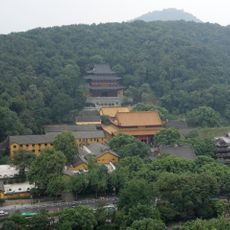
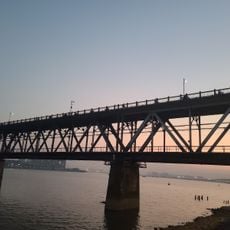
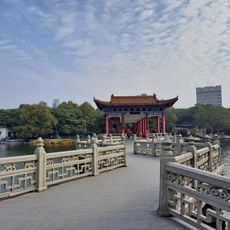
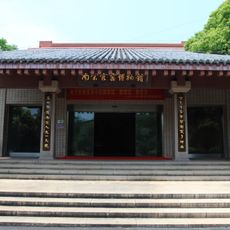
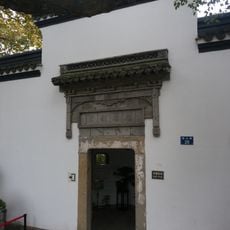
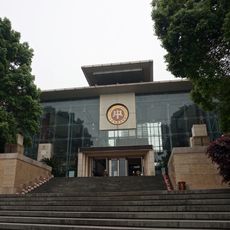
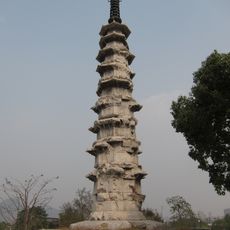
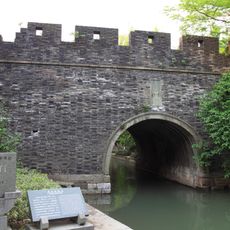
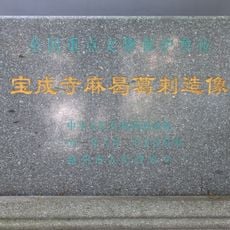
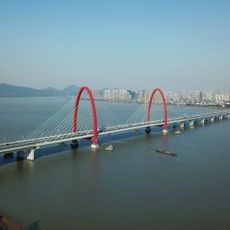
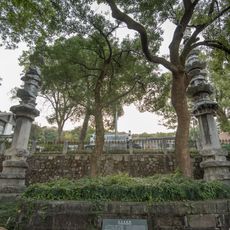
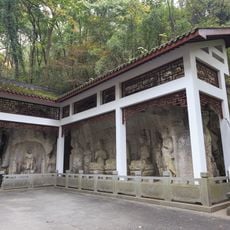
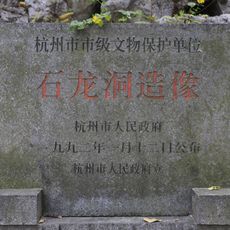
Autumn Moon on a Quiet Lake, Historic garden at West Lake, China.
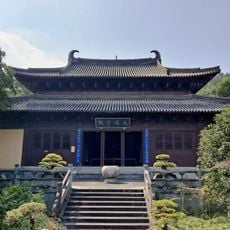
Autumn Moon on a Quiet Lake occupies a lakeside terrace at the southeast foot of Gushan Hill, where Baidi Causeway meets the shore of West Lake. Its stone platform, built in 1699, projects south over the water and is enclosed by railings; beside it stand the Yushu Tower, a stele pavilion and the Hutianyi Bi hall. The grounds cover 0.55 hectares.
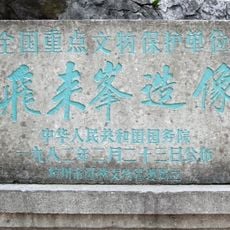
The name appears first among the Ten Scenes of West Lake in the Fangyu Shenglan, compiled in 1239 during the Southern Song. In 1699, on his third southern tour, Emperor Kangxi wrote the four characters for the scene; officials fixed the site at the old Wanghu Pavilion spot at the foot of Gushan, where a stone platform, railings and a stele pavilion were built.
The name comes from a Song-dynasty poetic title, and until the Ming the phrase meant simply boating on the lake on an autumn night to watch the moon, not a fixed spot. Wang Wei's quatrain on the theme opens with moonlight spread over the water "like a mat". In the late 1920s Lü Wencheng, visiting at Mid-Autumn, adapted a Jiangnan tune into the Cantonese piece Pinghu Qiuyue, recorded in Shanghai in 1930.
The site lies at the southeast foot of Gushan Hill, where Bai Causeway meets the lakeshore, and is reached on foot from the causeway. The viewing platform extends south over the water, keeping the sightline low and the view broad. The garden covers 0.55 hectares, expanded from 0.15 hectares in 1959 by adding the former Luo Yuan garden.
The Cantonese musician Lü Wencheng (1898–1981) composed a piece for gaohu also titled "Autumn Moon on a Quiet Lake" after visiting West Lake around the Mid-Autumn Festival in the late 1920s. Based on the Jiangnan silk-and-bamboo tune "Huan Ge", it was recorded in Shanghai in 1930 and became a standard of Cantonese music.
The community of curious travelers
AroundUs brings together thousands of curated places, local tips, and hidden gems, enriched daily by 93,850 contributors worldwide.