Noonday Gun, Artillery piece in Causeway Bay, Hong Kong.
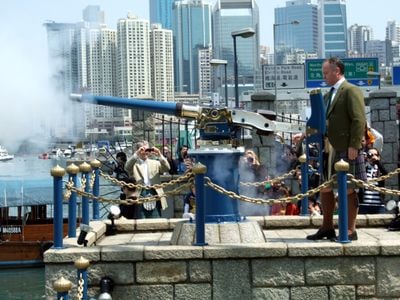
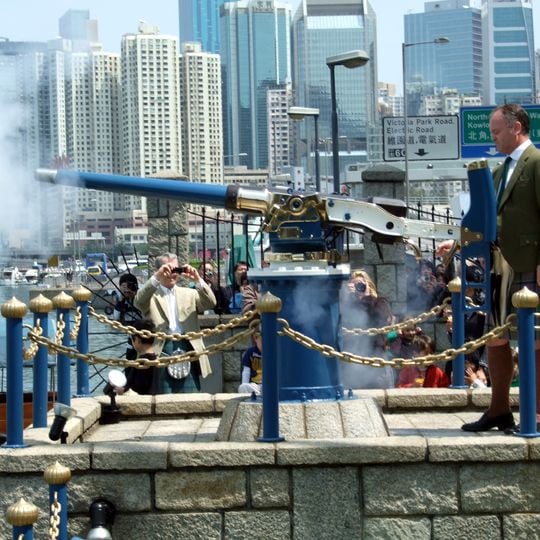
The Noonday Gun is a Hotchkiss three-pounder naval gun with a long blue barrel, mounted on a silver-white breech mechanism atop a square blue pedestal ringed in gold. It stands on a low stone masonry platform at the edge of the Causeway Bay Typhoon Shelter, enclosed by blue posts linked with a gold-colored chain. A Jardines guard in a dark green jacket and tie attends the firing.
Jardine Matheson's private militia at East Point fired salutes for arriving tai-pans until a senior British naval officer, new to Hong Kong, objected in the 1860s; as a penalty the firm had to fire a gun every noon. Japanese forces dismantled the gun in 1941 and it was lost. In 1947 the Royal Navy supplied a six-pounder, and in 1961 a Hotchkiss three-pounder used at the Battle of Jutland replaced it after noise complaints.
The name "Noonday Gun" comes from the daily noon shot, and the ritual begins with the guard ringing a bell eight times, a practice dating from the East Point offices and warehouses when it marked the end of the morning shift. On New Year's Eve a midnight shot is fired and "Auld Lang Syne" is played, a custom brought to Hong Kong from Edinburgh Castle, with pipers performing each year. Since 1989 a HK$48,000 donation to the Community Chest lets anyone pull the lanyard, raising over HK$5 million for charity.
The gun sits on an enclosed plot on the Causeway Bay Typhoon Shelter waterfront, reached by a tunnel under Gloucester Road from the basement car park of The Excelsior hotel on Gloucester Road. The guard rings the bell eight times before firing, so arrive a little before noon to see the full ritual.
Each noon a uniformed guard rings a bell before firing the cannon in a carefully choreographed ritual. This daily duty has been performed by the Jardine Matheson company, which has maintained this tradition through generations.
The community of curious travelers
AroundUs brings together thousands of curated places, local tips, and hidden gems, enriched daily by 92,767 contributors worldwide.