Zhengyangmen, City gate in Dongcheng District, Beijing, China
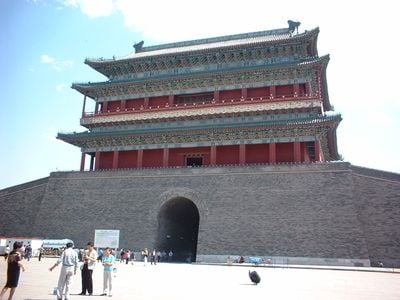
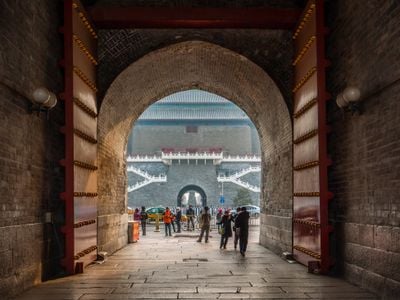
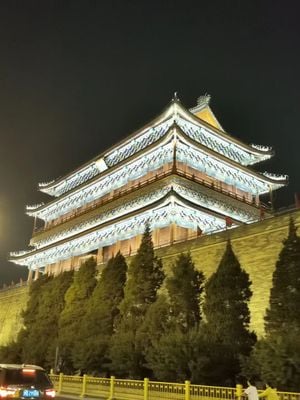
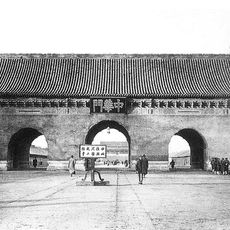
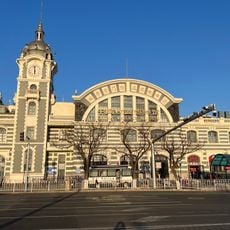
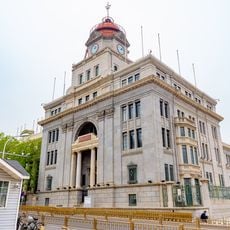
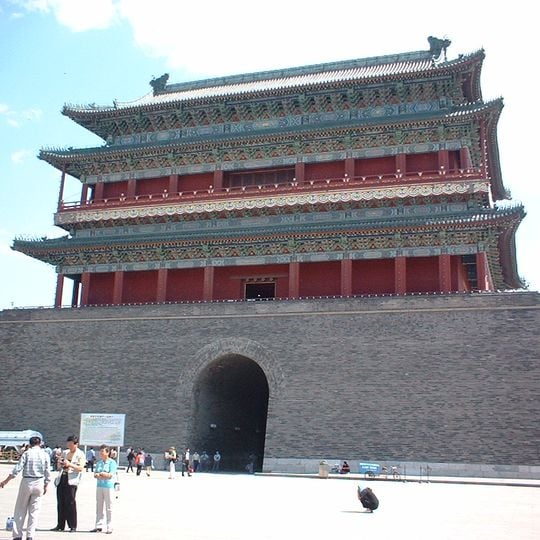
Zhengyangmen consists of a gatehouse and an archery tower. The gatehouse stands on a brick platform 95 metres wide and 14.7 metres high, topped by a 27-metre wooden hall with a double-eaved roof of grey tiles edged in green glazed tiles. The archery tower, a brick fortress with a central arched passage, has 94 arrow windows and a white marble balustrade along its platform.
Built in 1419 as Lizhengmen, the gate was renamed Zhengyangmen in 1439 after a barbican and archery tower were added. The archery tower burned in 1610, 1779 and 1849; in 1900 the Eight-Nation Alliance shelled it, and British Indian troops lit a fire that destroyed the gatehouse. The 1903 reconstruction copied Chongwenmen's gatehouse and Xuanwu's archery tower at larger scale.
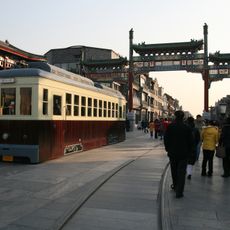
The gate's popular name, Qianmen ("Front Gate"), comes from its position at the southern entrance to the Inner City. In 1610 two temples stood inside the barbican: a Guanyin temple on the east and a Guandi temple on the west. Both were demolished in 1958. Since the 2000s redevelopment, Qianmen Street has been dominated by international brands, and the nearby Qianshi hutong is Beijing's narrowest.
The site is easily accessible by public transport, with subway lines 2 and 8 nearby and multiple bus routes serving the area. The surrounding Qianmen district offers restaurants, shops, and sits close to Tiananmen Square, making it simple to explore other nearby attractions.
The plaque marking China's highway zero point lies just outside the gate, engraved with the four cardinal points, four animals and the words "Zero Point of Highways, China" in Chinese and English. The gatehouse, 42 metres tall, is the tallest of Beijing's city gates and the only Ming-Qing gate tower of the Inner City still standing.
The community of curious travelers
AroundUs brings together thousands of curated places, local tips, and hidden gems, enriched daily by 93,488 contributors worldwide.