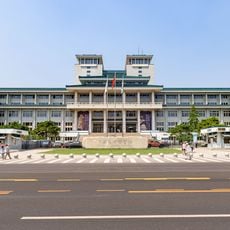
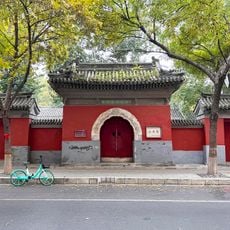
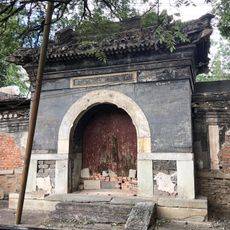
Dahui Temple, Buddhist temple in Haidian District, China
Dahui Temple, also called the Great Buddha Temple, preserves only its Dabe Hall: a double-eaved hip-roof hall of five bays by three, reached by seven steps, with diamond-pattern windows between the eaves. Inside stand a wooden lacquered standing Buddha with two attendants, and 28 Ming polychrome clay guardian deities, each about 3 m tall, on two 1.1 m Sumeru pedestals.
The temple was founded in 1513 by Zhang Xiong, a eunuch of the Ming court's Directorate of Ceremonial. Under the Jiajing emperor an additional 183 rooms and 421 mu of grounds were recorded, and the temple was rebuilt in 1592 and again in 1757 under the Qianlong emperor. It declined after the Guangxu era; in 1933 fire destroyed the bronze Guanyin statue, leaving only its head and torso, later encased in a wooden replacement figure.
The temple is also known as Dafo Temple, after a gilded bronze Thousand-Hand Guanyin statue over ten meters tall that stood in the Dabe Hall until a fire on 24 October 1933 destroyed it; only the head and torso survived and were later incorporated into a wooden statue. The hall's walls carry a Ming-dynasty连环 mural based on the Guanyin legend by Yuan-dynasty painter Guan Daosheng.
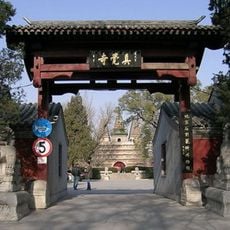
The temple at 11 Dahui Si Road, Haidian District, is not open to visitors; only the Dabeibao Hall survives, surrounded by a residential compound reached by a lane from the public road. Residents oppose opening it to visitors crossing their compound, so check access before travelling.
The statues date to the Ming Dynasty and display intricate carvings and religious symbolism in their design. Each figure showcases detailed craftsmanship that reflects the artistic skill of that historical period.
The community of curious travelers
AroundUs brings together thousands of curated places, local tips, and hidden gems, enriched daily by 93,578 contributors worldwide.