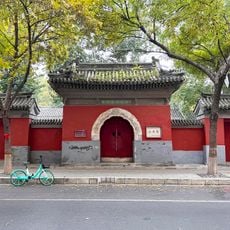
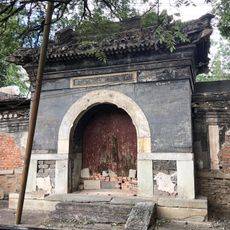
Zhenjue Temple, Buddhist temple in Haidian District, Beijing, China.
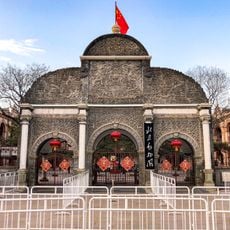
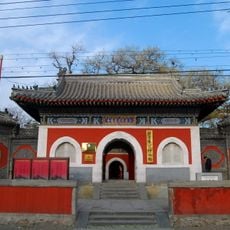
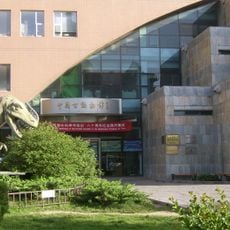
Zhenjue Temple is a Buddhist sanctuary in Haidian featuring a foundation that supports five pagodas, with four positioned at the corners and one central tower rising 17 meters above ground level. The complex now houses the Beijing Art Museum of Stone Carvings and carries protected status as a national monument.
The site belonged to the Yuan-era Dashengshou Wansui Temple, founded in 1270 for the Tibetan master Pakpa Lodro Gyeltsen, whose relics were placed in a stupa there after 1280. The Ming Chenghua Emperor built the present Diamond Throne Pagoda in 1473, following designs and five golden Buddha statues brought by the Indian monk Sariputra. The wooden halls burned in 1860 and 1900; only the stone pagoda survived.
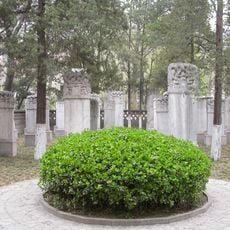
The temple walls display intricate carvings of one thousand Buddhas, Buddhist symbols, animals, and floral designs on white marble surfaces. This skilled stonework reflects the importance of visual devotion in Buddhist practice.
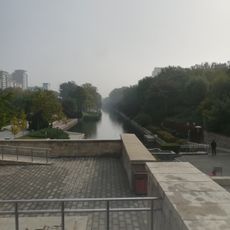
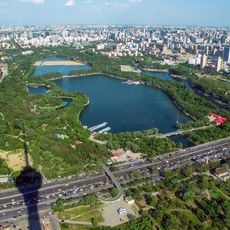
The temple stands on the north bank of the Gaoliang River, east of Baishiqiao in Haidian District. The stone pagoda is the only structure to survive; the pedestal of the former Big Treasure Hall remains on the grounds. Two ginkgo trees over 300 years old stand in front of the pagoda, each requiring three people to encircle.
The pair of Buddha footprints carved in relief on the south face of the central pagoda's base is the only such raised carving in Beijing; elsewhere footprints are cut inward. The pedestal was once coated with a protective layer made from pig blood, putty, flour and glutinous rice paste, and dark red traces remain in the recesses of the carvings.
The community of curious travelers
AroundUs brings together thousands of curated places, local tips, and hidden gems, enriched daily by 93,760 contributors worldwide.