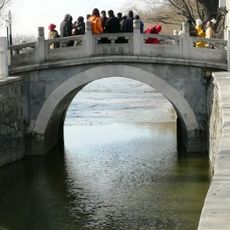
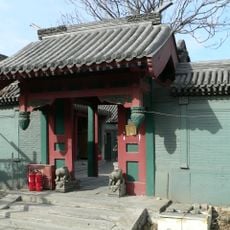
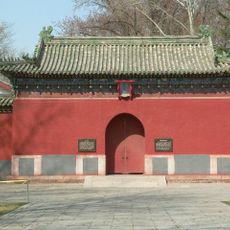
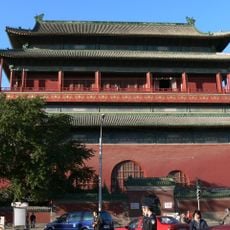
Wanning Bridge, Stone arch bridge in Shichahai Subdistrict, China.
Wanning Bridge is a single-arch white marble bridge on Di'anmen Outer Street, spanning the restored Yu River just east of the Qianhai lake in Beijing. Its balustrades are carved with lotus and vase motifs, and the railings were replaced in the Qing dynasty. A three-arch marble bridge was added west of it in 2000.
Built in 1285 during the Yuan dynasty, it originally served as a transportation hub with a valve system to manage boat traffic on the waterway. The structure has remained in its original position for over seven centuries, making it one of the oldest constructions on Beijing's Central Axis.
Locals call it Houmen Bridge because it stood north of Di'anmen, the rear gate of the imperial city. The name Wanning was adopted after the 2000 restoration, when the Yu River was brought back above ground. A Ming-era stone post found in the silt in 1950 bore a rat and the characters for "Beijing", recalling the saying that Beijing lies beneath the bridge.
The bridge connects the north and south sections of Di'anmen Outer Street, accommodating both vehicles and pedestrians crossing the waterway. The location is easily accessible on foot and offers views of the surrounding historic area and waterway.
The bridge displays water-control sculptures depicting Baxia, one of the nine sons of the Dragon King, originally designed to prevent water overflow. These mythological figures are visible remnants of the ancient water management system that functioned for centuries.
The community of curious travelers
AroundUs brings together thousands of curated places, local tips, and hidden gems, enriched daily by 94,408 contributors worldwide.