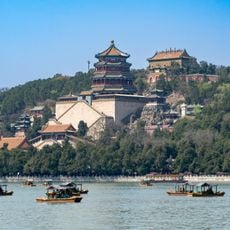
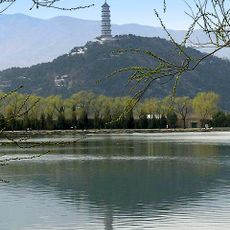
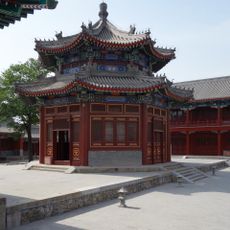
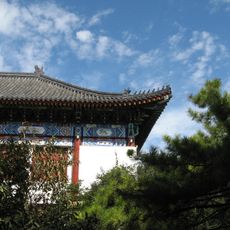
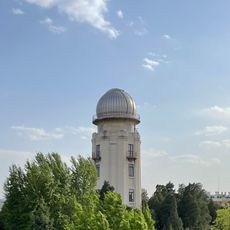
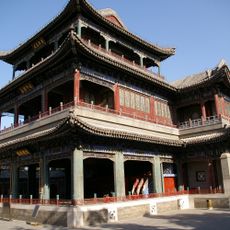
Tower of Buddhist Incense, Octagonal Buddhist pavilion on Longevity Hill in the Summer Palace, Beijing, China.
The Tower of Buddhist Incense is an octagonal structure located on Longevity Hill within the Summer Palace grounds. The building features three levels and four roof eaves supported by eight thick pillars, rising to approximately 41 meters tall.
The tower began as the nine-storey Yanshou Pagoda under Emperor Qianlong; he ordered it dismantled at the eighth storey and rebuilt as a pavilion modelled on Wuhan's Yellow Crane Tower. Anglo-French forces destroyed it in 1860, and it was rebuilt on the same site during the Guangxu reign (1875–1908).
Three gilded plaques hang on the facade, one per storey, reading from top to bottom "Shi Yang Feng Jiao", "Qi Xiang Zhao Hui" and "Yun Wai Tian Xiang". Cixi came on the first and fifteenth days of each lunar month to burn incense before the Buddha. The Guanyin now displayed was moved here in 1988, when over 300 Summer Palace staff carried the five-ton bronze by hand from Wanshou Mituo Temple.
The tower stands on the front slope of Longevity Hill, reached by stone stairways from the lakefront; the climb is steady, so allow time and wear shoes with grip. Entry is through the Tower of Buddhist Incense and Paiyun Hall scenic area, which charges a separate ticket from the rest of the Summer Palace. Visitor numbers are capped inside, so expect to wait at busy periods.
The Guanyin statue inside was cast in 1574, during the Ming Wanli era, in gilded bronze, standing 5 meters tall and weighing 5 tons. It originally stood in the Daci Hall of the Wanshou Mituo Temple. During the Cultural Revolution, teacher Chen Changgeng and others from Ya'er Hutong Primary School hid it to keep it intact; in 1988 more than 300 Summer Palace staff carried it by hand into the tower, which opened to visitors on 2 October 1989.
The community of curious travelers
AroundUs brings together thousands of curated places, local tips, and hidden gems, enriched daily by 93,832 contributors worldwide.