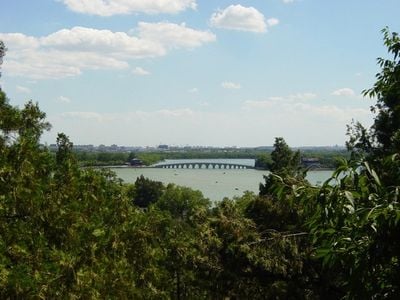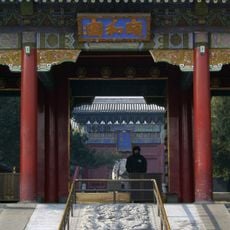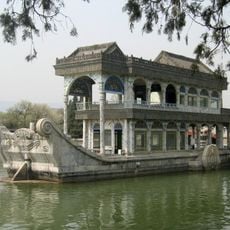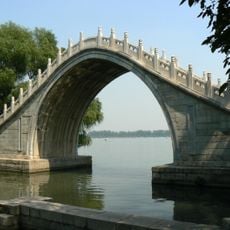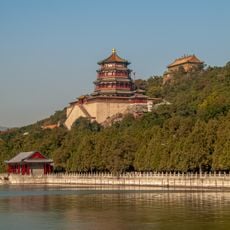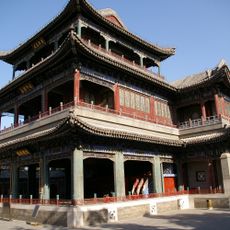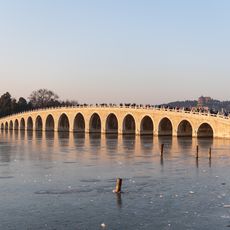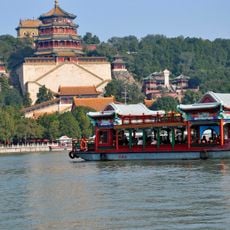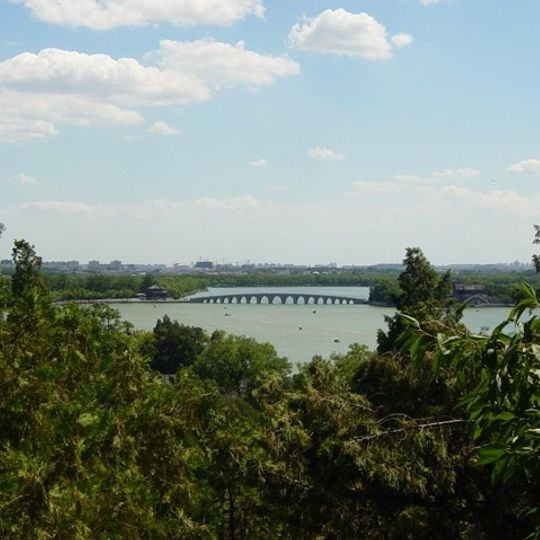
Kunming Lake, Reservoir at Summer Palace, Beijing, China
The lake covers approximately 2.2 square kilometers and takes up three quarters of the Summer Palace, with an average depth of about 1.5 meters. The water is bordered by gentle banks that connect pavilions, bridges, and manicured gardens throughout the grounds.
The lake's predecessors, Wengshan Pond and Xihu Lake, served as reservoirs for city water and field irrigation for about 3,500 years. In 1291 Guo Shoujing turned it into a reservoir for the Yuan capital. Between 1750 and 1764 the Qianlong Emperor had the area made into an imperial garden, and nearly 10,000 labourers enlarged the lake.
The lake's layout follows the "one pond, three hills" (一池三山) scheme: South Lake Island, Round Fort Island and Algæ-view Hall Island stand in a tripod, representing the immortals Penglai, Yingzhou and Fangzhang from the Classic of Mountains and Seas. The name Kunming Hu comes from a Han-dynasty pool where Emperor Wu drilled naval warfare, and summer manoeuvres were held here under the Qing.
Visitors can explore the water with boat tours or walk along the eastern and western dams, which offer viewing points. Most walking paths pass by temples and garden areas, providing various spots to rest and take in the surroundings.
The 1990–1991 dredging was the lake's first in 240 years; 652,600 cubic metres of sludge came out, and with it 205 Japanese bombs dropped during the Sino-Japanese War. The bronze ox on the eastern shore, placed facing the Forbidden City, was meant to hold back floods, echoing the legend of Yu the Great's iron ox.
The community of curious travelers
AroundUs brings together thousands of curated places, local tips, and hidden gems, enriched daily by 93,465 contributors worldwide.