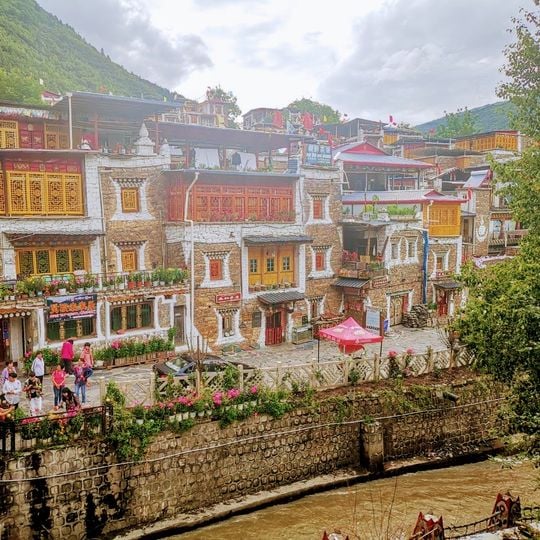
卓克基土司官寨, Historical fortress in Sichuan Province, China.
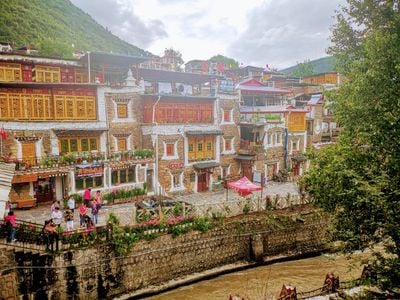
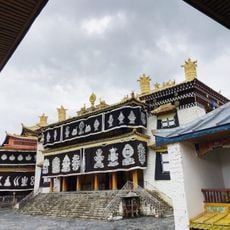
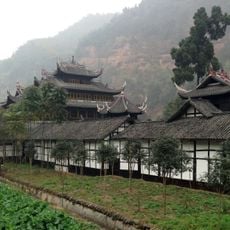
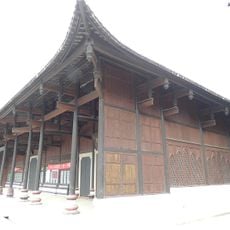
Zhuokeji Tusi Castle is a stone-and-wood official residence built between 1938 and 1940 on a terrace about 7 km east of Markang. Its four wings enclose a central courtyard, with a two-storey Tibetan flat-roofed south block and four- to five-storey悬山顶 wings; a square watchtower connects to the third floor. The walls are 1.1 m thick and the complex has 63 rooms.
The fortress was established as an administrative seat during the Qing Dynasty, where local chieftains controlled their territory while acknowledging imperial rule. This dual role shaped both the architecture and the operations of the site throughout that era.
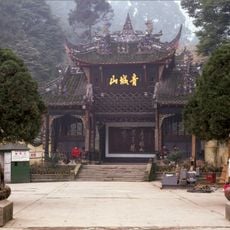
The fortress blends Han Chinese and Tibetan architectural styles in its decorations and building techniques, showing how different peoples lived and worked together in this region. This cultural fusion remains visible in every part of the structure today.
The residence stands about 7 km east of Markang town, at the junction of National Road 317 (to Lixian and Chengdu) and Provincial Road 210 (to Xiaojin), at roughly 2,700 m elevation. It faces Xisuo Village across the Xisuo River, and the village houses and Dandarlun Monastery face the residence. The main building is a four-sided courtyard with a central light well and wooden galleries; the square watchtower connects to the third floor.
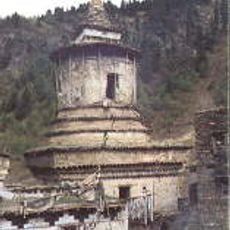
The square stone watchtower beside the main building connects to its third floor and was used to store valuables and shelter people in emergencies; it also stood as a symbol of the tusi's power. The south block is a two-storey Tibetan flat-roofed structure, while the other wings rise four to five storeys with overhanging gable roofs reserved for tusi buildings.
The community of curious travelers
AroundUs brings together thousands of curated places, local tips, and hidden gems, enriched daily by 94,534 contributors worldwide.