Stele of Quejin Pavilion, Protected cultural monument in Guancheng District, Dongguan, China
The Stele of Quejin Pavilion is a stone monument with traditional Chinese inscriptions housed within a pavilion structure. The site preserves written records documenting local events and regional history in stone form.
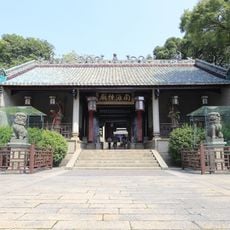
The stele was erected in 1542, the year after the Quejin Pavilion was built with a hundred taels of silver raised by Siamese merchants to thank Panyu magistrate Li Kai for refusing their payment. In 1592–1599 Guangdong censor Liu Hui restored the pavilion and stele, adding two lines recording his and Dongguan magistrate Li Wenkui's supervision. The pavilion had collapsed by the 1960s; Dongguan rebuilt it in 1997, and the stele became a national key cultural relic in 2006.
The inscriptions document local stories and traditions that shaped the region. The calligraphy itself reflects the artistic values of its time and how people valued written records.
The stele stands at the junction of Guangming Road and Jiaochang Street in the Beiyu community of Guancheng Subdistrict, Dongguan. It is a roadside stone marker, so it is seen on foot while passing along the street; no interior visit or booking is involved. The inscription faces outward and can be read from the pavement.
The stele's top edge is rounded and carved with a pattern of clouds and a rising sun, framing the five seal-script characters "Quejin Ting Bei Ji". The text below runs in 21 columns of exactly 50 characters each, with cloud motifs around the border. The title was brushed by Zheng Yitong, a compiler at the Hanlin Academy; the text was composed by Guangdong censor Yao Yu and written out by Lin Yingliang of the Ministry of Rites.
The community of curious travelers
AroundUs brings together thousands of curated places, local tips, and hidden gems, enriched daily by 94,244 contributors worldwide.