Joss House Bay Rock Inscription, Declared monument and inscribed stone in Sai Kung District, Hong Kong
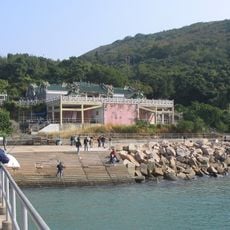
The Joss House Bay Rock Inscription is a granite rock face carved with Chinese characters on the coast of Sai Kung District, Hong Kong, near the Tin Hau Temple at Tai Miu Wan. The text is cut directly into the stone surface above the waterline and remains legible despite long exposure to coastal weather.
The inscription was carved in 1274, the tenth year of the Xianchun era of the Southern Song, on the orders of Yan Yizhang, a salt official of the Guanfu salt field, and his companion He Tianjue of Sanshan. Its 108 characters in nine lines record earlier repairs to the North and South Buddha Halls and the South Hall's stone pagoda, built in 1012. It was found in 1955 by the architect Yu Qian.
The inscription records that the salt officer Yan Yizhang and He Tianjue came to visit the two shrines, and that local man Lin Daoyi later expanded the shrines and asked for a new stone to be carved. The text names the donors and builders of the shrines, including Zheng Guangqing, Teng Lejue and Xin Daopu, showing how officials and local residents jointly maintained the site.
The rock sits right at the shoreline next to the Tin Hau Temple at Tai Miu Wan and is reached on foot from a small parking area at the end of the road. Wear shoes with good grip since the ground near the water can be uneven and slippery.
What sets this inscription apart from others in the region is that it carries an exact date, which is rare for rock carvings of this kind. That date makes it the oldest dated Chinese text found on Hong Kong territory.
The community of curious travelers
AroundUs brings together thousands of curated places, local tips, and hidden gems, enriched daily by 93,811 contributors worldwide.