Geyuan Temple, Buddhist temple in Laiyuan County, China
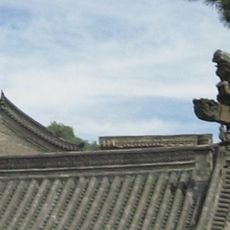
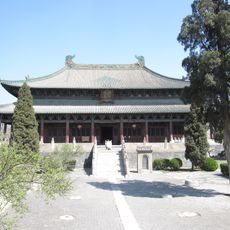
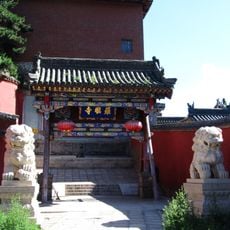
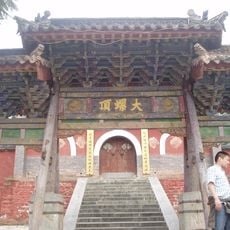
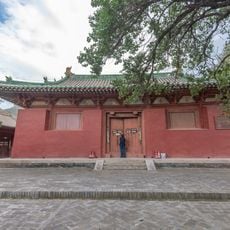
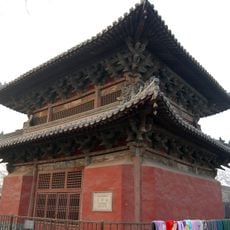
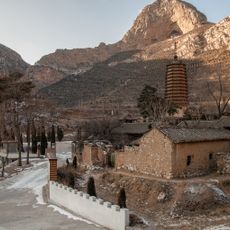
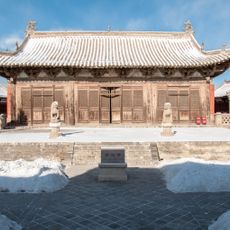
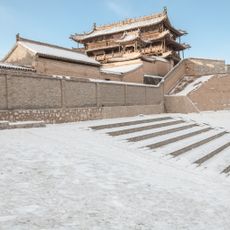
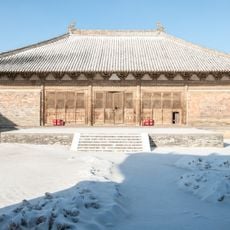
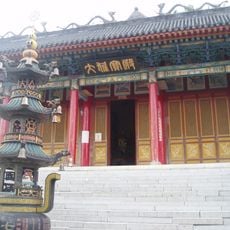
Geyuan Temple (阁院寺) is a Buddhist temple in Laiyuan County, Hebei, whose main hall, the Wenshu Hall, is a square Liao-dynasty timber structure measuring 15 by 15.67 metres and rising 12.5 metres, built on a raised platform. The temple's three main buildings face west rather than along a north–south axis: the Wenshu Hall, a Ming-dynasty sutra pavilion, and the Tianwang Hall, originally the mountain gate.
The temple was originally built during the Han Dynasty and later reconstructed in the Tang Dynasty period. The Wenshu Hall that stands today dates from 966 CE during the Liao Dynasty and represents this construction phase.
The temple's name, "Ge Courtyard Temple," comes from the surname Ge. The 1,200-character inscription on the Feihu Bell, cast in 1114, records that it was made to pray for Emperor Tianzuo and the princes and princesses. The bell hangs in the open southeast of the Wenshu Hall, and its six lugs, representing the six roots of Buddhism, produce different tones.
The temple faces south, with the Tianwang Hall, Wenshu Hall and sutra pavilion in sequence from south to north; the grounds cover 900 square metres, of which 484 are built over. The temple was closed for restoration from 2009 and reopened on 1 May 2026. The Feihu Bell, cast in 1114, hangs on an open frame southeast of the Wenshu Hall.
The Wenshu Hall is the only known Chinese hall that is three bays wide, square in plan, and built with reduced columns (jianzhu zao). Its two original columns were carbon-dated to the Tang dynasty, while two others were added later. The hall's lattice windows mix Liao, Yuan, Ming and Qing styles because they were replaced over the centuries.
The community of curious travelers
AroundUs brings together thousands of curated places, local tips, and hidden gems, enriched daily by 94,497 contributors worldwide.