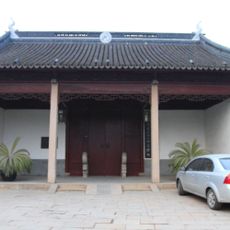
Linyanshan Temple, Buddhist temple in Suzhou, China
Lingyanshan Temple stands on Lingyan Hill in Suzhou, on the site of the palace of King Fuchai of Wu, where Xishi lived in 494 BC. The two-tiered hall has dark grey tiled roofs with upturned eaves, a lower roof over dark brown wooden lattice panels between yellow side walls, and an upper row of small-paned windows beneath a central blue plaque with gold Chinese characters. A red flag flies from a tall silver pole in front of the facade, above a tiered gold-coloured incense burner flanked by potted plants.
The temple was first built by Lu Wan, a Minister of Works of the Eastern Jin, on Lingyan Hill. In 503 it was expanded as Xiufeng Temple, and in 516 Emperor Wu of Liang declared it the manifestation site of Zhiji Bodhisattva. It became a Pure Land practice site in 1926 when Master Yinguang established it as a ten-direction Pure Land monastery.
The temple serves as a gathering place for Pure Land Buddhist practitioners who regularly participate in ceremonies and group meditation sessions throughout the year. The site remains an active spiritual center where local devotees uphold traditional Buddhist practices in daily worship.
The temple is located in Suzhou's Wuzhong District and accessible to visitors through established pathways and entry points. Designated areas accommodate prayer, personal reflection, and group gatherings that welcome both worshippers and tourists.
The temple stands on the ruins of Guanwa Palace, built by King Fuchai of Wu for Xi Shi around 494 BC; the sources call this conversion of a pleasure palace into a Buddhist site unmatched in Chinese Buddhist history. Its founding patriarch is Zhiji Bodhisattva, a figure said to have manifested on Lingyan Hill, which the sources describe as very rare.
The community of curious travelers
AroundUs brings together thousands of curated places, local tips, and hidden gems, enriched daily by 93,892 contributors worldwide.