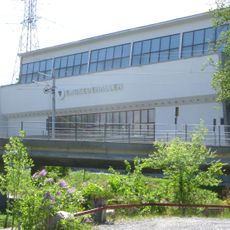
Hammarbyslussen, navigation lock in Stockholm, Sweden
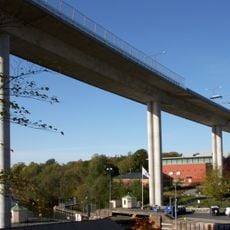
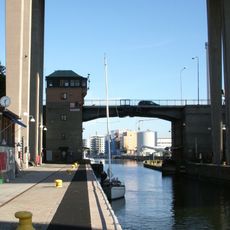
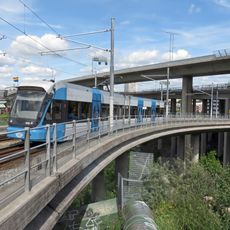
Hammarbyslussen is a lock in Stockholm linking Årstaviken, part of Lake Mälaren, with Hammarby sjö, which belongs to the Baltic Sea. Its chamber measures 115 metres long, 17.4 metres wide and 6.29 metres deep over the sills. Three bridges cross it: Skansbron, Skanstullsbron and Johanneshovsbron.
Hammarbyslussen was built in the mid-1920s as part of Hammarbyleden, the water route decided in 1914 as a major infrastructure project in southern Stockholm, and it opened in 1930. The same project produced the Danvik Canal (1930), the bascule bridges Danviksbron (1922), Skansbron (1925) and Liljeholmsbron (1928), and the high Årstabron over Årsta holmar (1929). The lock chamber measures 115 metres long, 17.4 metres wide and 6.29 metres deep over the sills.
Hammarbyslussen separates Årstaviken, which belongs to Lake Mälaren, from Hammarby sjö, part of the Baltic Sea, so the lock marks the boundary between two water systems. It was built as part of Hammarbyleden, decided in 1914 and inaugurated in 1930, together with Danvikskanalen and several bridges. Three bridges cross the lock: Skansbron, Skanstullsbron and Johanneshovsbron.
Visitors can watch the lock operate from walkways around the site without interfering with boat traffic. It helps to visit in the morning or afternoon when more boats are typically passing through.
The lock chamber is 115 metres long, 17.40 metres wide and 6.29 metres deep over the sills, with 10.4 metres of clearance under Skansbron when it is closed. Three bridges cross the lock: Skansbron, Skanstullsbron and Johanneshovsbron.
The community of curious travelers
AroundUs brings together thousands of curated places, local tips, and hidden gems, enriched daily by 94,616 contributors worldwide.