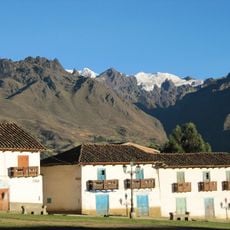
Tumshukayko, Archaeological site in Caraz, Peru.
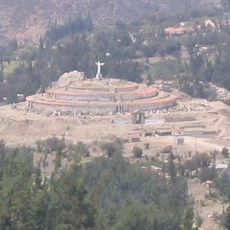
Tumshukayko is a pre-Inca monumental complex 1 km north of Caraz, on the right bank of the Llullán river at 2300 m elevation. Its fine stonework forms a circular structure of platforms, terraces and stairways, with lower semi-circular walls spaced about 2.4 m apart, the gaps filled with loose rock and earth. The outer walls carry geometric carvings, and the site extends roughly 300 m in diameter and 25 m in height.
The site dates from the Late Preceramic period around 2000 BCE and was later occupied by the Recuay culture between 300 BCE and 300 CE. This sequence shows a long history of use at this location across different cultural periods.
The site's name, Tumshukayko, means "core" or "centre" in Quechua. Its most notable artefacts are stone heads (cabezas clavas) and triangular stones, which point to a link with the early Chavín culture; the artistic work resembles finds at the Moxeke complex in the Casma Valley.
The site is located about one kilometer north of Caraz and is reachable from local tourism offices. Visitors should bring proper footwear for uneven ground and prepare for the higher elevation.
The site displays semi-circular walls arranged at regular intervals, suggesting deliberate planning in its design. This consistent pattern is uncommon in sites from this period and hints at specialized construction purposes.
The community of curious travelers
AroundUs brings together thousands of curated places, local tips, and hidden gems, enriched daily by 94,089 contributors worldwide.