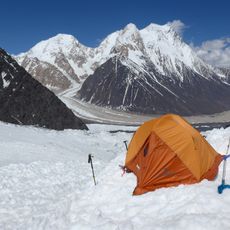
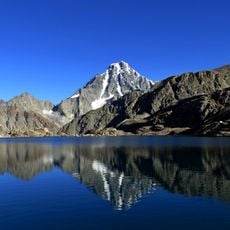
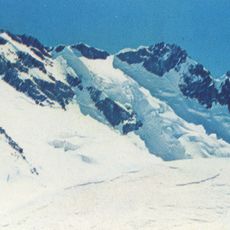
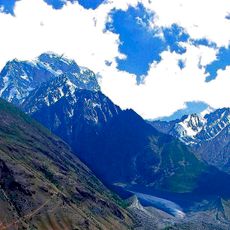
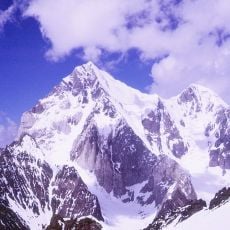
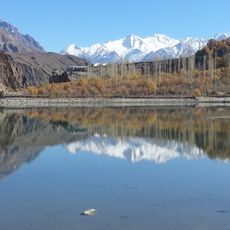
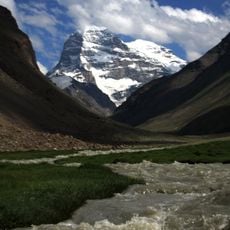
Noshaq, Mountain summit in Wakhan Corridor, Afghanistan.
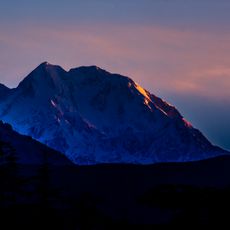
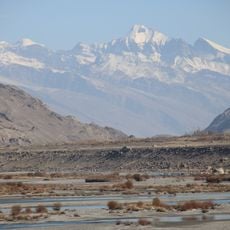
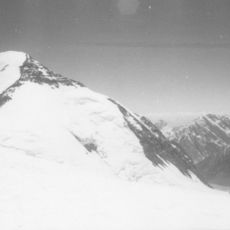
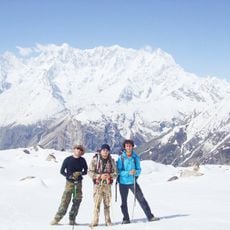
Noshaq is a 7,492 m peak on the Afghanistan–Pakistan border, the highest mountain in Afghanistan and the westernmost 7,000 m peak in the world. Its upper face is snow and ice cut by dark rock bands, with a broad snow slope falling to the lower left and a jagged, snow-streaked ridge standing to the right.
Noshaq's main summit was first climbed on 17 August 1960 by a Japanese expedition led by Professor Yajiro Sakato, with Goro Iwatsubo and Toshiaki Sakai, via the west ridge from the Qazideh Glacier. A Polish team reached the top ten days later, on 27 August. The east, central and west summits fell in 1963 to Austrians Gerald Gruber and Rudolf Pischenger. From the 1978 Saur Revolution and the following decades of war the mountain was hard to reach; in 2011 National Geographic reported the summit trail accessible again.
Noshaq's name appears as نوشاخ in Persian and نوشک in Pashto, the languages spoken on either side of the border. The first Afghan ascent came in July 2009, and in August 2018 Hanifa Yousoufi became the first Afghan woman to reach the summit.
Climbers should prepare for extreme altitude and highly variable weather conditions while planning expeditions during the summer months when conditions are most favorable. Access to the region demands careful preparation, and ascents should be undertaken with experienced local guides and complete high-quality mountaineering gear.
The February 1973 winter ascent by Tadeusz Piotrowski and Andrzej Zawada, up the north face, was the first winter climb of any 7,000 m peak and remains the only winter ascent of Noshaq. The Polish team reached the top on 13 February.
The community of curious travelers
AroundUs brings together thousands of curated places, local tips, and hidden gems, enriched daily by 92,571 contributors worldwide.