Sierra Velluda, Pleistocene stratovolcano in Bío Bío Region, Chile.
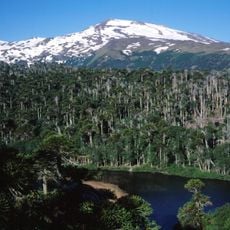
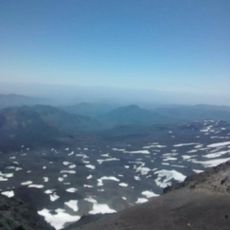
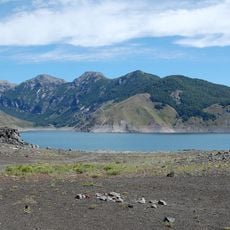
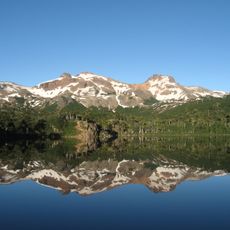
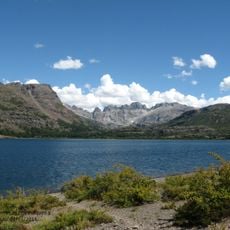
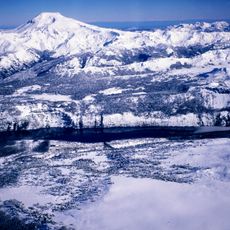
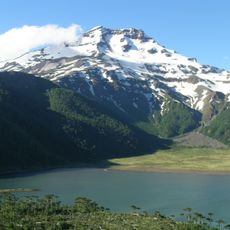
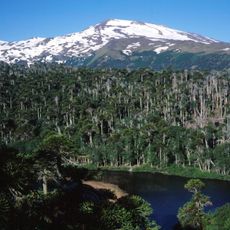
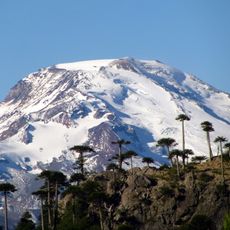
Sierra Velluda is a stratovolcano in the Bío Bío Region that dominates the landscape of Laguna del Laja National Park with its two distinct summits. This mountain reaches 3,585 meters in elevation and stands as the park's highest peak.
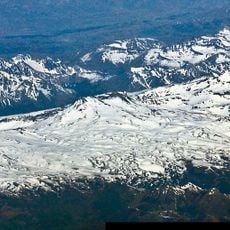
Sierra Velluda was built in two stages. The first, dated to 495,000 years ago, left about 1.5 km of breccia and lava flows with sporadic pyroclastic flows; the second, dated to 381,000 years ago, added 3 km of breccia and lava. Later glacial erosion cut back the ice-covered slopes and exposed the older layers.
The name comes from a saddle shape formed by the two summits: explorer Eduard Poeppig, who first climbed Antuco in 1829, sketched the massif as "Silla de Bermudas". Local speech turned this into Sierra Velluda. Another account, followed by writer Carlos Elgueta, traces it to Fernando Belluga de Moncada, scribe of the Cabildo of Los Infantes de Angol, whose surname was also written Velluga, giving "Silla de Velluga".
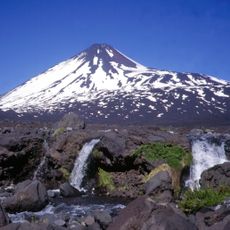
The mountain lies immediately southwest of Antuco Volcano inside Laguna del Laja National Park. The first ascent of the north summit (3,585 m) was made on 17 January 1940 by E. Fahrenkrog, K. Kroessig and H. Tilly via the Canaleta Oeste route; the central summit (3,518 m) was first climbed on 28 December 1948 by A. Mercado and V. Sepúlveda. Its western slopes drain into the Duqueco River.
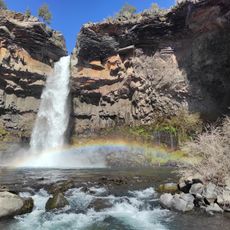
Glacial erosion has revealed the ancient volcanic layers, exposing geological structures spanning nearly half a million years. These visible rock formations tell the story of repeated volcanic activity across vast timescales.
The community of curious travelers
AroundUs brings together thousands of curated places, local tips, and hidden gems, enriched daily by 92,783 contributors worldwide.