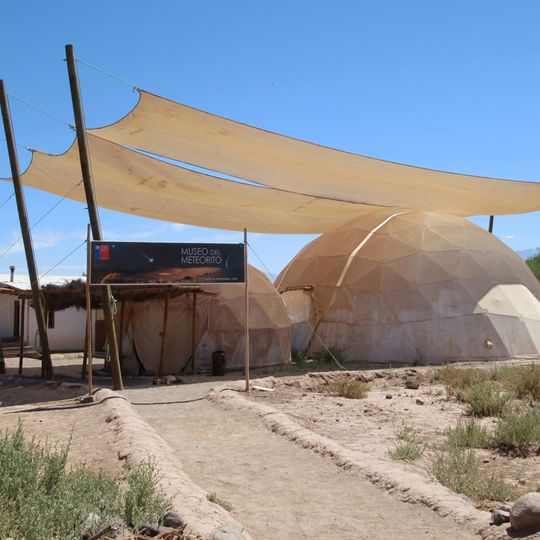
Meteor Museum, Meteorite science museum in San Pedro de Atacama, Chile
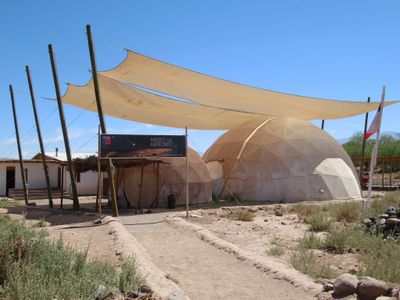
The Meteor Museum in San Pedro de Atacama holds more than 6,000 meteorites collected in the Atacama Desert since 1983, when a pallasite was found beside the Imilac crater. Its four sections cover the search for meteorites and their impact craters, the evolution of rocky planets, meteorites as precursors of extraterrestrial life, and a sensory area called Touching the Stars. A preliminary laboratory classifies the pieces.
Meteorite collecting here began in 1983, when a single pallasite was found beside the Imilac crater in the Antofagasta Region. The collection grew to more than 6,000 specimens, studied and certified by NASA, UCLA and CEREGE. The museum was formally constituted on 12 May 2008 as Museo del Meteorito E.I.R.L.
The museum's collection was studied, classified and certified by NASA, UCLA and CEREGE, the Aix-en-Provence geosciences centre. Its four sections are named "Entry, search and impact craters of meteorites in the Atacama Desert", "Meteorites and the evolution of rocky planets in the solar system", "Meteorites as precursors of extraterrestrial life" and "Touching the stars", an interactive and sensory area.
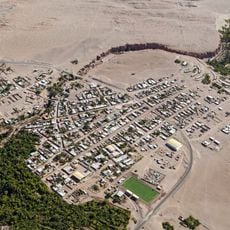
The museum is in San Pedro de Atacama, in the Antofagasta Region. Inside, a preliminary laboratory is used to analyse and classify the meteorites, and the collection is arranged in four thematic sections, the last of which, "Touching the Stars", is an interactive and sensory area.
The museum's collection began in 1983 with a single pallasite found beside the Imilac crater in the Atacama Desert. That find grew into more than 6,000 specimens, studied and certified by NASA, UCLA and CEREGE. A preliminary laboratory at the museum is used to analyse and classify the meteorites.
The community of curious travelers
AroundUs brings together thousands of curated places, local tips, and hidden gems, enriched daily by 94,226 contributors worldwide.