Ponte de Pedra, Stone bridge monument in Largo dos Açorianos, Porto Alegre, Brazil
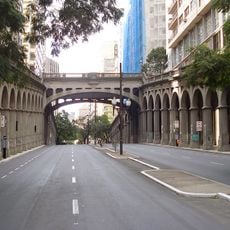
Ponte de Pedra is a stone structure with three arched pillars located in Largo dos Açorianos that stands as a focal point in the urban landscape. The monument features a water mirror installation beneath its arches, which forms a design element of the plaza.
A wooden bridge stood on the site from around 1825 and was rebuilt repeatedly after floods. In 1843, before the end of the Farroupilha War, the provincial president Duque de Caxias ordered a masonry replacement, built by João Batista Soares da Silveira e Sousa with enslaved labour at a cost of 980 contos. It opened unfinished in 1848, closed to traffic that March, and was completed in 1854. The Dilúvio was straightened in 1937 and the bridge was listed by the municipality in 1979.
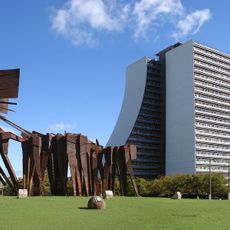
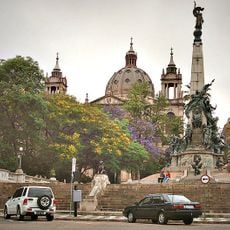
The bridge is also called "Ponte dos Açores" because it stands in Largo dos Açorianos, next to the Monumento aos Açorianos honouring settlers from the Azores. An undated oil painting of the bridge by Luís Maristany de Trias (1885–1964) hangs in the MARGS museum.
The bridge stands in Largo dos Açorianos, beside the Monumento aos Açorianos, in central Porto Alegre. The square was reopened to the public in 2019 after restoration work that emptied and refilled the lake, and the water level was kept low so part of the three arched pillars stays visible. Look for the pillars at the waterline rather than a full reflection.
The bridge was painted by Luís Maristany de Trias (1885–1964); the undated oil canvas hangs in the Museu de Arte do Rio Grande do Sul (MARGS). Its three arches once spanned a branch of the Dilúvio that forked near today's Colégio Estadual Protásio Alves.
The community of curious travelers
AroundUs brings together thousands of curated places, local tips, and hidden gems, enriched daily by 92,814 contributors worldwide.