Gua Sunyaragi, Cave palace complex in Cirebon, Indonesia.
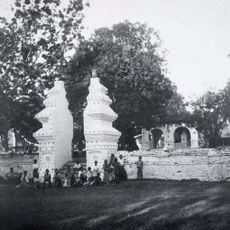
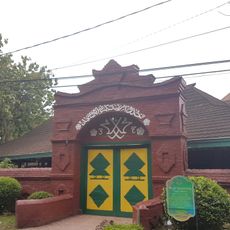
Gua Sunyaragi is a water-garden complex in Cirebon built from reddish-brown rock carved into irregular mounds and terraces. At the top stands a rectangular pavilion on square pillars, with a small peaked-roof structure in front; below, the rock is hollowed into dark cave chambers and passages. A shallow pool sits at the base, and a stepped reddish-orange arch stands to the right.
According to the Caruban Nagari, written by Pangeran Kararangen (also called Pangeran Arya Carbon) in 1720, Sunyaragi was founded in 1703 by that prince, great-grandson of Sunan Gunung Jati. He built only the Arga Jumut cave complex and Mande Kemasan; the site was later repeatedly altered and repaired. The Carub Kanda tradition links its creation to the Giri Nur Sapta Rengga retreat becoming the Astana Gunung Jati burial ground.
The name Sunyaragi comes from the Sanskrit sunya (quiet) and ragi (body). The complex mixes Indonesian-Hindu joglo roofs, Chinese flower carvings, Islamic qibla niches and pawudlon ablution spots, and European windows and a spiral staircase. Two caves face Mecca and China, reflecting the sultans' claimed descent from Sunan Gunung Jati.
The site is reached via Jl. By Pass Brigjen Dharsono in Sunyaragi village and is relatively easy to access. Visiting early morning or late afternoon works best, as it's cooler and less crowded.
The name Sunyaragi comes from the Sanskrit sunya (empty, quiet) and ragi (body), so it reads as "a quiet body". Two of the artificial caves face particular directions: one toward Mecca, since the sultans of Cirebon claim descent from Sunan Gunung Jati, and one toward China, following the tradition that Gunung Jati was of Chinese origin.
The community of curious travelers
AroundUs brings together thousands of curated places, local tips, and hidden gems, enriched daily by 93,898 contributors worldwide.