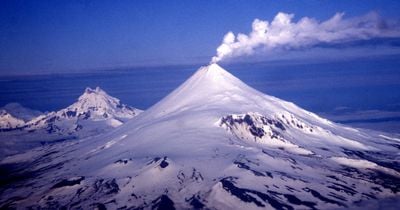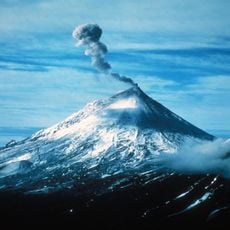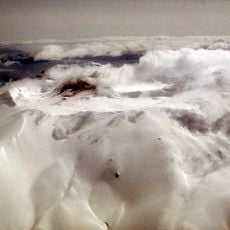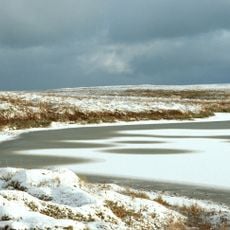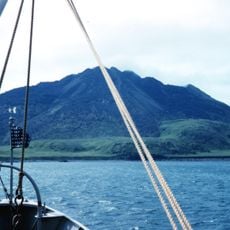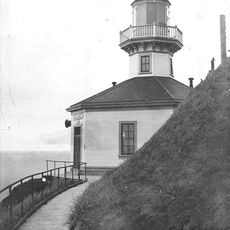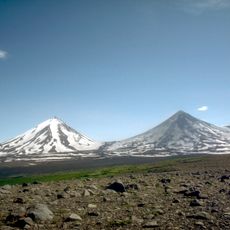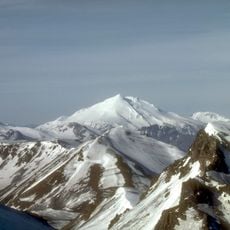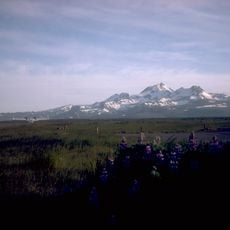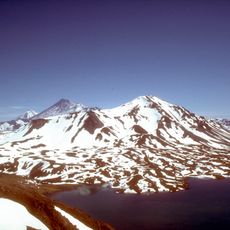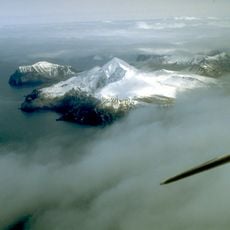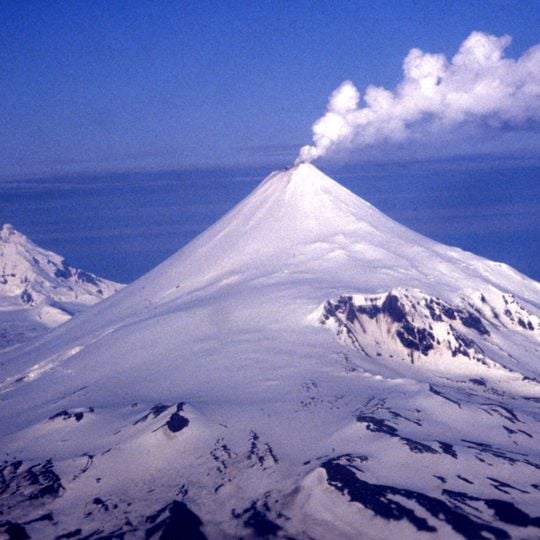
Mount Shishaldin, Active stratovolcano on Unimak Island, Alaska.
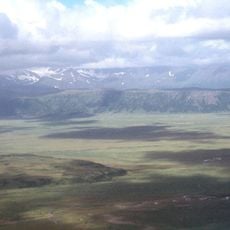
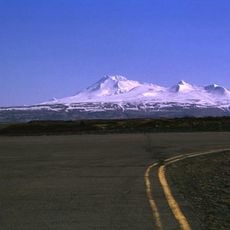
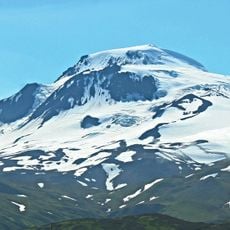
Mount Shishaldin is an active stratovolcano on Unimak Island rising to about 2,900 meters above sea level. Its symmetrical cone is built from basalt and sits on a broad base that extends across the island's landscape.
The modern cone is less than 10,000 years old and was built atop the glacially eroded remnant of an ancestral volcano, whose rougher rocks are exposed on the west and northeast flanks between 1,500 and 1,800 m. Written records of eruptions began in 1775 with Russian explorers and traders, and 40 Holocene eruptions have since been confirmed, including a sub-Plinian VEI 3 event on 19 April 1999.
The Aleut people called this mountain Sisquk, meaning the peak that guides lost travelers. The name reflects how this striking summit served as a natural landmark for navigation across the region.
The nearest settlement is False Pass, about 45 km away, and the view from there is blocked by Round Top and Isanotski, so eruptions often go unseen. The Alaska Volcano Observatory monitors the volcano remotely with satellite data and a six-seismometer network installed in 1997. The first recorded ascent was in 1932.
The modern cone is less than 10,000 years old and its contour lines above 2,000 m form near-perfect circles, deviating from a true circle by only about 2,000 m. The ancestral cone, rougher in surface, is exposed on the west and northeast flanks between 1,500 and 1,800 m.
The community of curious travelers
AroundUs brings together thousands of curated places, local tips, and hidden gems, enriched daily by 92,787 contributors worldwide.