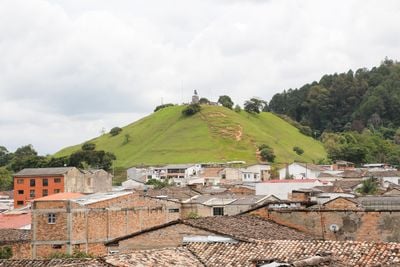
Morro del Tulcán, Pre-Columbian pyramid in Popayán, Colombia.
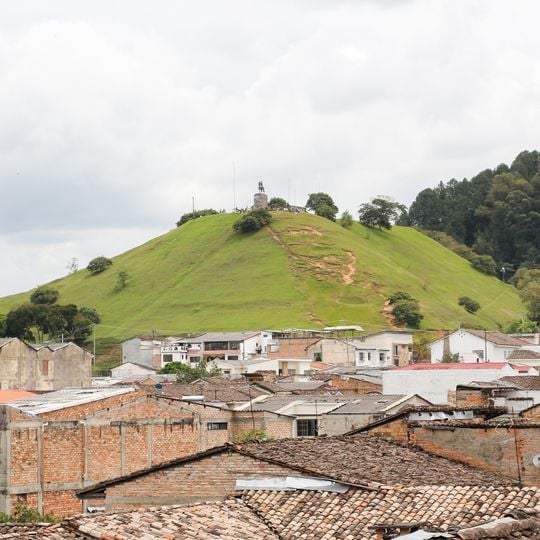
Morro del Tulcán is a rounded grassy hill in Popayán whose flattened summit was cut in 1940 to hold a pedestal. Excavations in 1957 found adobe walls, stone paving on the upper part, steps and tombs, and concluded that a lake once surrounded the structure. The hill is now covered with kikuyu grass, with exposed earth running up its slopes.
The truncated hill was built with adobe walls and earth fill between roughly 1600 and 500 BCE, in the period called Late Chieftain Societies. In March 1957 a storm exposed a 3 m adobe-mosaic wall; Julio César Cubillos Chaparro began digging on 15 July 1957 for the Universidad del Cauca, finding stone paths, steps and tombs. Around 1940 the summit was levelled for a Belalcázar monument, destroying two adobe walls.
The name Tulcán is still unexplained, and the summit's use changed in 1940 when the pyramid top was levelled for an equestrian statue of Sebastián de Belalcázar by Victorio Macho. Poet Guillermo Valencia protested: "de una obra de arte hicieron un pisa papel". On 16 September 2020 Misak demonstrators pulled the statue down; the Universidad del Cauca then announced excavations would resume.
The site is open year-round and sits within the city of Popayán, making it easy to reach on foot from downtown. Visitors should wear comfortable shoes, as the paths to the top climb uphill and can be slippery in wet weather.
The 1957 dig by Julio César Cubillos Chaparro opened 13 trenches and found stone paths, stone paving on the upper part, steps and tombs, plus seashells and precious stones brought from other regions. He also concluded that a lake, natural or artificial, once surrounded the mound.
The community of curious travelers
AroundUs brings together thousands of curated places, local tips, and hidden gems, enriched daily by 92,796 contributors worldwide.