Tonantzintla Observatory, Research observatory in San Andrés Cholula, Mexico
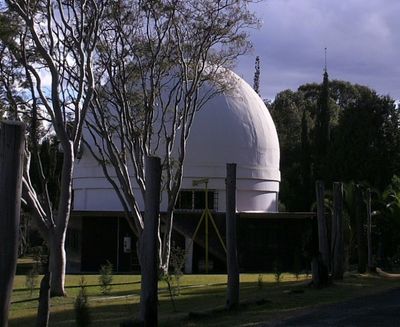
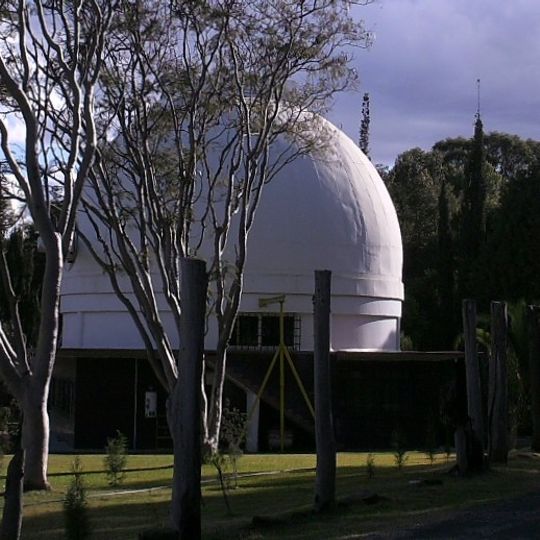
Tonantzintla Observatory in San Andrés Cholula, Puebla, comprises two adjacent facilities: OANTON, run by INAOE on its campus, and OAN-Tonantzintla, run by UNAM on mostly unused land to the east. OANTON's main instrument is a 0.7 m Schmidt camera built in the Harvard College Observatory shops with PerkinElmer optics and installed in 1942. OAN-Tonantzintla houses a 1.0 m Cassegrain reflector that saw first light in 1961.
The observatory was dedicated on 17 February 1942 by President Manuel Ávila Camacho, a project begun by astronomer Luis Enrique Erro, its first director until 1947. Guillermo Haro took over in 1948 and led the creation of INAOE in 1971. The adjacent OAN-Tonantzintla, founded in 1878 on Chapultepec Castle's balcony, moved here in 1951 after light pollution degraded its Tacubaya site.
The Tonantzintla Catalogue (TON), a list of stars, was published in the Bulletin of Tonantzintla and Tacubaya Observatories. Objects such as Tonantzintla 1 (Pismis 25), discovered by James Dunlop in 1826 and catalogued by Paris Pismis in 1959, carry the observatory's name. The 0.7 m Schmidt camera, installed in 1942, is still in use and has not been upgraded with a digital sensor.
Bring appropriate clothing for the high altitude location, as temperatures can drop significantly in the evening. Check ahead about visiting conditions and hours, as the facility prioritizes research activities.
The 0.7 m Schmidt camera installed in 1942 was built in the Harvard College Observatory shops with optics from PerkinElmer, and it has never been fitted with a digital sensor. Guillermo Haro used it to study Herbig–Haro objects in detail.
The community of curious travelers
AroundUs brings together thousands of curated places, local tips, and hidden gems, enriched daily by 93,763 contributors worldwide.