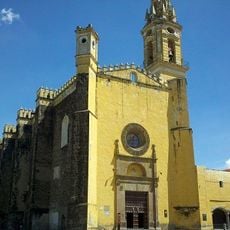
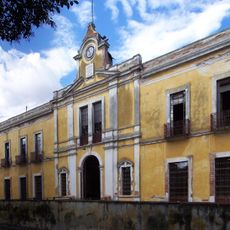
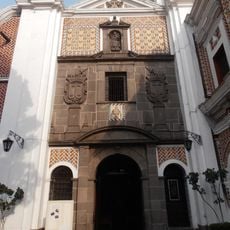
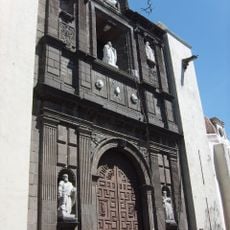
Santa María Tonantzintla, Baroque church in Tonantzintla, Mexico.
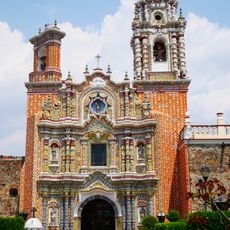
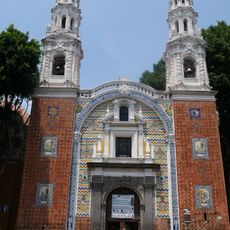
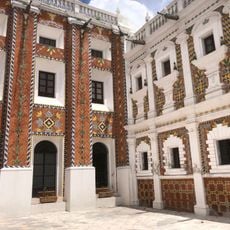
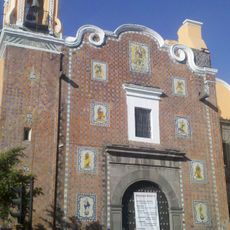
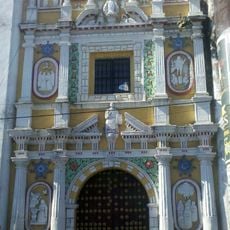
Santa María Tonantzintla is a church in San Andrés Cholula, Puebla, Mexico, built in four phases from the 16th to the 19th century. Its interior has a Latin-cross plan with a dome and transept, four carved cedar altars, and walls and vaults covered in stucco and wood carving. The facade is clad in partly raw, partly glazed azulejos.
A first small chapel was built in the second half of the 16th century, served by Franciscan friars from the San Gabriel convent. The current church was begun in the second half of the 17th century with a single nave, cupola and bell tower; in the 18th century a transept was added, the nave was extended toward the facade, and the facade was renewed. Interior decoration began at the end of the 17th century and was largely finished in the 18th, with the choir vault completed at the end of the 19th century. The church was declared a Monumento histórico on 11 November 1933.
The name Tonantzintla comes from Nahuatl and refers to the goddess Tonantzin, meaning "place of our revered mother"; the village was founded in 1587 and named for both the Virgin Mary and Tonantzin. In the church atrium, images of saints with natural hair recall a custom in which girls whose prayers were answered cut their hair and offered it in thanks.
The church is in Tonantzintla, part of San Andrés Cholula, near Puebla. It was declared a historic monument on 11 November 1933 and is the third most visited church in Puebla, so expect crowds. Look for the facade covered in glazed azulejos and the atrium images with real hair.
In 1951 choreographer José Limón made a dance titled "Tonantzintla" based on the nave decoration; its U.S. premiere was at Jacob's Pillow. In the atrium, images of saints wear real hair, donated by girls whose requests were granted.
The community of curious travelers
AroundUs brings together thousands of curated places, local tips, and hidden gems, enriched daily by 94,775 contributors worldwide.