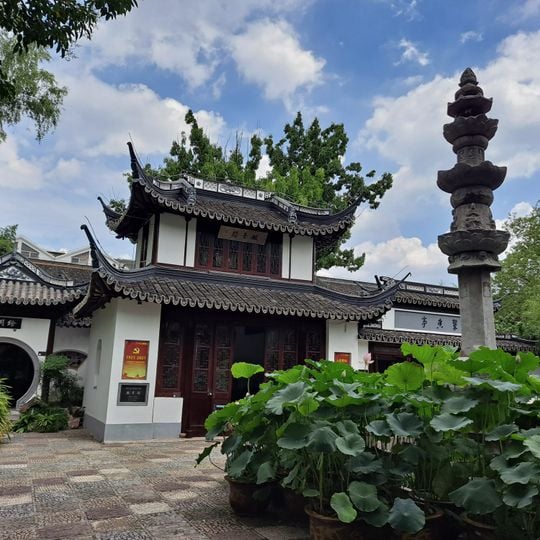
Guyi Garden, Classical Chinese garden in Nanxiang, Jiading District, Shanghai.
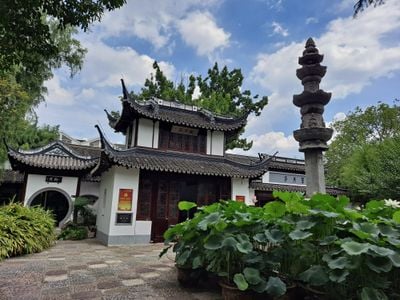
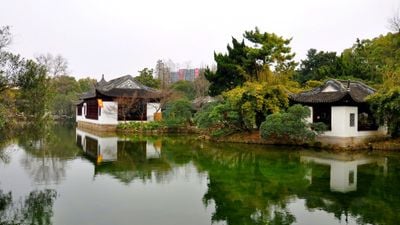
Guyi Garden is a 10-hectare site featuring stone pathways, pavilions, bridges, and halls arranged around water features according to traditional Jiangnan design principles. The layout connects different architectural elements into a single landscape where water, buildings, and vegetation blend together functionally.
Min Shiji, a Henan magistrate, built the garden during the Jiajing era (1522–1566) of the Ming dynasty; it was designed by the Jiading bamboo carver Zhu Sansong. In 1746 the Dongting native Ye Jin bought it and rebuilt it, renaming it Guyi Garden in 1748. Local gentry purchased it in 1789 as the spiritual garden of the prefectural City God Temple.
The name comes from a line in the Book of Songs, 'green bamboo lush and abundant,' referring to the bamboo that still fills the garden. The Yiye Hall, first built in the Ming dynasty, was destroyed during the Japanese occupation and rebuilt in 1979. The garden is also the birthplace of Nanxiang xiaolong steamed buns.
The garden opens in early morning hours and closes at dusk, with exact times varying by season. Wear comfortable shoes to explore the multiple pathways, bridges, and spaces throughout the site.
Qingqing Yuan, the garden's largest section at about 30 mu, lies east of the main grounds. Its name comes from a line in the Book of Songs praising lush bamboo, and the area was planted with bamboo as a feature. The garden's original name, Yi Yuan, also drew on this verse.
The community of curious travelers
AroundUs brings together thousands of curated places, local tips, and hidden gems, enriched daily by 94,014 contributors worldwide.