Huacheng Temple, Buddhist temple in Qingyang County, China.
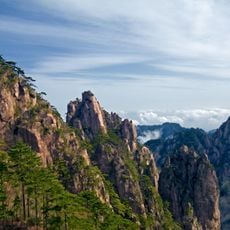
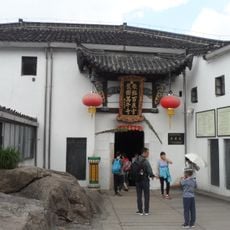
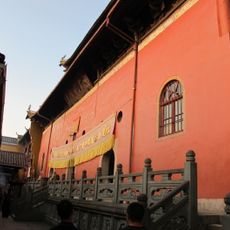
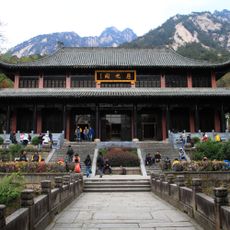
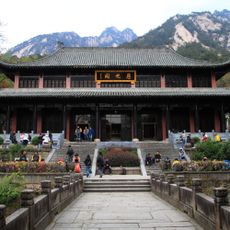
Huacheng Temple is a Buddhist temple in Qingyang County located on Mount Jiuhua, featuring traditional Chinese architectural design with its buildings arranged across the mountainside. The complex contains multiple halls filled with altars, statues, and sacred texts organized through different levels and courtyards.
An Indian monk, Huaidu, is said to have built a small Buddhist temple here in 401 CE. In 781 CE the governor of Chizhou, Zhang Yan, moved the old "Huacheng" board to this site, and after Jin Qiaojue died in 794 CE the temple was dedicated to Ksitigarbha. In 1391 the abbots Zongling and Fajian expanded it into a Chan temple; in 1681 Yu Chenglong renovated it into 72 halls, and after its destruction in 1857 only the Sutra Library survived until the 1890 rebuilding.
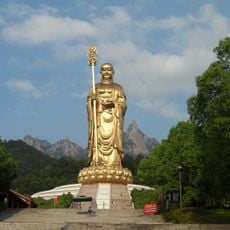
The temple is the bodhimanda of Ksitigarbha, a status tied to the monk Jin Qiaojue, whom fellow monks regarded as the bodhisattva's incarnation after his death in 794 at age 99. At the start of the Chinese New Year, its 1,000-kilogram bell is rung 108 times, a number matching the 12 months, 24 solar terms and 72 hou.
The temple sits on a mountainside, so wear sturdy shoes and allow time for walking uphill to reach different areas. Local guides are available on site to lead you through the complex and explain the purpose and layout of each section.
A 1,000-kilogram bronze bell, 2 metres high, was cast between 1875 and 1908 under the Guangxu Emperor. At the start of the Chinese New Year it is struck 108 times, a number matching the 12 months, 24 solar terms and 72 hou of the traditional calendar.
The community of curious travelers
AroundUs brings together thousands of curated places, local tips, and hidden gems, enriched daily by 94,599 contributors worldwide.