Tomb of Hai Rui, Historic cemetery in Longhua District, Haikou, China
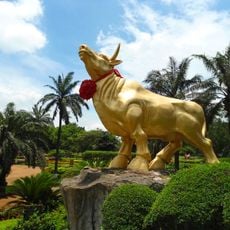
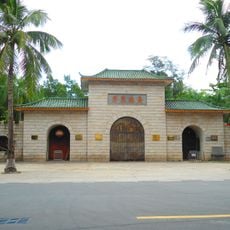
Tomb of Hai Rui is a Ming-dynasty burial ground in Haikou, Hainan, completed in 1589. A stone archway inscribed "Yuedong Zhengqi" opens onto a paved spirit path lined with stone rams, horses, lions, a tortoise and human figures, with two further arches over the path. At the end stands a 3-metre granite tomb mound in the shape of an ancient bell, hexagonal at the base and tapering to a round top, fronted by a stele, five incense burners and a large stone offering table.
Built in 1589, this tomb honors a high-ranking official whose career defined opposition to corruption and abuse of power. The burial site itself became meaningful through a local story about a rope breaking during his funeral procession.
Hai Rui (1514–1587), a native of Qiongshan in Guangdong, earned the name "Hai Qingtian" (Hai of the Clear Sky) for his blunt remonstrance and refusal to bend. When he died in office in Nanjing, his estate could not cover the funeral, so the censor Wang Yongji collected money from colleagues to bury him. The tombstone was composed by Xu Ziwei, a fellow townsman and pupil of Hai Rui, who supervised the construction as imperial commissioner.
The tomb stands at 39 Qiuhai Avenue in the Haiken subdistrict of Longhua District, in the western suburbs of Haikou. The grounds face south: a stone archway inscribed "Yuedong Zhengqi" opens onto a flagstone path lined with stone animals and figures, leading north to the grave mound. The on-site Hai Rui relics exhibition room sits on the left side of the grounds.
Local tradition holds that this location was chosen for the burial when a rope carrying the coffin snapped during the funeral procession at this exact spot. This event connected the site to a sense of fate in the community's memory.
The community of curious travelers
AroundUs brings together thousands of curated places, local tips, and hidden gems, enriched daily by 94,936 contributors worldwide.