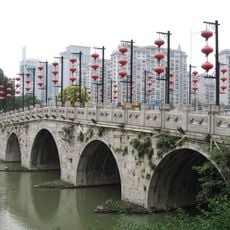
蒲塘桥, Stone arch bridge in Lishui District, China.
The Putang Bridge is a stone arch bridge in Lishui with a curved design characteristic of traditional construction methods. The structure was built without modern machinery, relying on techniques that engineers developed centuries ago.
A post road from Lishui to Xuancheng crossed the Putang River here; after the old bridge collapsed in the late Southern Song, a ferry took its place. In 1508 the wealthy local brothers Zhao Qi began rebuilding it with 3,000 taels of their own silver, and it was finished in 1512. Magistrate Chen Xian renamed it Shangyi Bridge in 1515 to honour the donation, though the old name returned. It was repaired in 1946 and 1955, restored in 2009–2010, and listed nationally in 2012.
The bridge is named after Putang village, and its nine arches gave the river crossing the local name "nine jars." In 1515 magistrate Chen Xian renamed it Shangyi Bridge to honour the Zhao brothers' donation, though the original name returned. Today it is a pedestrian bridge; its 72 pillars each carry a small stone lion.
Since a new bridge was built west of it, Putang Bridge has served only as a pedestrian crossing, so visitors walk the 91.3-metre stone deck between the 72 lion-topped pillars. The bridge was reinforced and repaired between December 2009 and July 2010, when the concrete surface was removed and the original stone paving restored.
During the 2009–2010 restoration, workers clearing vegetation from the bridge found a carved stone dragon head and put it back in its original position, adding three more dragon heads to complete the set. The eight piers each carry a pointed cutwater that splits the current.
The community of curious travelers
AroundUs brings together thousands of curated places, local tips, and hidden gems, enriched daily by 93,650 contributors worldwide.