Gate of China, Ming Dynasty gate complex in Nanjing, China
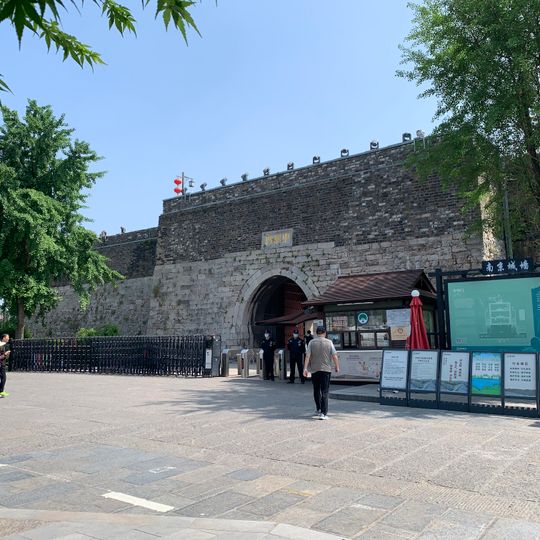
The Gate of China is a Ming-era gate and defensive complex on Nanjing's city wall, with a rampart 20.45 m high and a footprint of 118.5 m east to west by 128 m south to north. Its four arched gates are linked by three barbicans, and 27 soldier-staying holes are built into the structure. The photograph shows a grey brick wall with a rounded-arch gateway, a stone plaque with vertical Chinese characters above it, and red lanterns near the top left.
The gate was built between 1360 and 1386 as part of the Ming city wall ordered by Zhu Yuanzhang, who made Nanjing his capital in 1368. It stood on the site of the Southern Tang south gate and was originally called Jubao Gate, meaning "Gathering Treasure Gate." In 1931 the Republic of China government renamed it Zhonghua Gate.
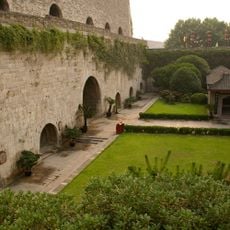
The gate was called Jubao Gate, "Gathering Treasure Gate", after Jubao Mountain near Yuhuatai; in 1931 the Republic of China government renamed it Zhonghua Gate. Inside, part of the 27 soldier-staying holes now serve as souvenir shops, and a replica of the gate's upper wooden building was installed in 2007.
The site is straightforward to navigate, though visitors should wear sturdy shoes as the complex includes multiple levels and steep areas to climb. Arriving early in the day helps you explore the structures at a comfortable pace and observe architectural details without crowding.
The complex has 27 soldier-staying holes, and some of these vaulted chambers now serve as souvenir shops. The gate could garrison 3,000 defenders, and a replica of its upper wooden pavilion was installed in 2007.
The community of curious travelers
AroundUs brings together thousands of curated places, local tips, and hidden gems, enriched daily by 93,935 contributors worldwide.