Gullfoss, Waterfall in Biskupstungur, Iceland
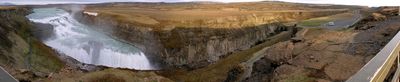
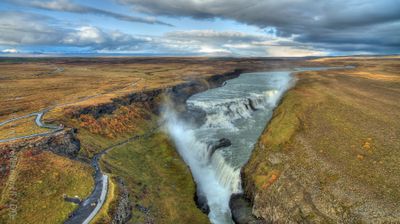
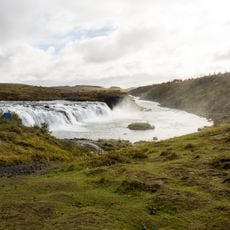
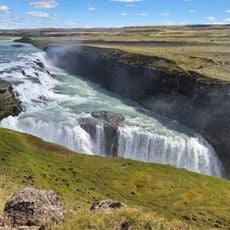
Gullfoss is a waterfall in Bláskógabyggð formed by two separate drops along the Hvítá river that together descend about 32 meters (105 feet). The cascades throw glacier-fed water into a narrow canyon whose dark volcanic walls taper downward.
Around 1920 an English company leased Gullfoss to build a dam and generate electricity. Sigríður Tómasdóttir of the nearby farm Brattholt campaigned against the scheme with lawyer Sveinn Björnsson, later president of Iceland, and the contract lapsed over a late rent payment. A 1977 plan to divert three quarters of the river was also rejected, and the falls became a conservation site in 1979.
The name Gullfoss means "Golden Falls". Sigríður Tómasdóttir, daughter of co-owner Tómas Tómasson, campaigned around 1920 against a planned power station, reportedly threatening to throw herself into the falls; a stone memorial above the falls shows her profile. A 1977 plan to divert three quarters of the water was also rejected.
A visitor center with restrooms and a café sits near the viewing platforms, which are connected by paved paths. The site remains open year-round, though winter conditions can make paths icy and require sturdy footwear.
In summer, the flow can reach 140 cubic meters (4,944 cubic feet) per second, creating a spray cloud that often forms a rainbow. The canyon itself is roughly 70 meters (230 feet) deep and only 21 meters (69 feet) wide, giving the impression that the water vanishes into the earth.
The community of curious travelers
AroundUs brings together thousands of curated places, local tips, and hidden gems, enriched daily by 92,654 contributors worldwide.