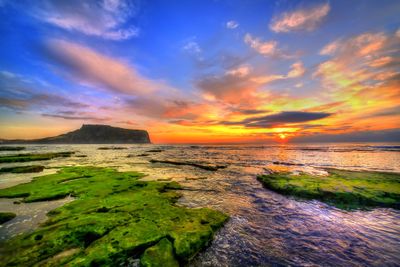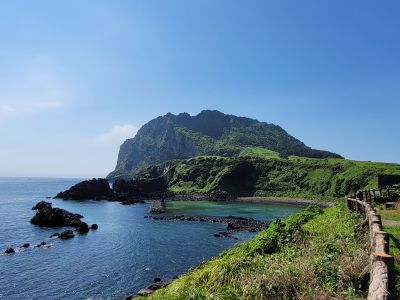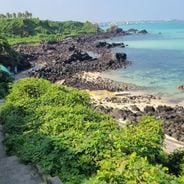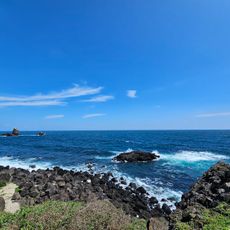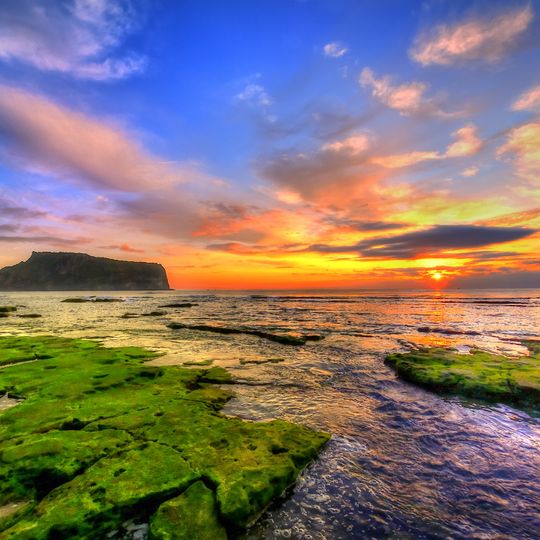
Seongsan Ilchulbong, Volcanic tuff cone in Jeju Island, South Korea.
Seongsan Ilchulbong is a 182-meter tuff cone on Jeju Island with a grassy, bowl-shaped crater about 600 meters wide. Its seaward cliffs expose layered volcanic deposits, while the landward slope retains its original gradient. The crater floor lies roughly 90 meters above sea level.
This volcanic cone formed approximately 6,700 years ago through hydrovolcanic eruption on the shallow seabed near Jeju Island. The eruption created a robust structure composed of volcanic ash and rock fragments, which has endured and shaped the eastern landscape.
The name joins two old designations: Seongsan, "fortress mountain," for its fortress-like profile, and Ilchulbong, "sunrise peak." The Seongsan Sunrise Festival runs for several days around New Year's Day, with talent shows, parades, fireworks, trail walks and traditional gut shamanic rituals; a countdown ends at sunrise, when fishermen light their boats and sound whistles.
A wooden staircase leads to the summit, with the climb taking roughly 30 minutes and being fairly straightforward for most visitors. The path is well-maintained with viewing points along the way, so staying on the marked route keeps you oriented and safe.
The crater floor lies about 90 m above sea level, and the rim is a smooth grassy edge, not a ring of rock spikes. The inner bowl is shallow and oval, with a lower centre. The 2011 survey counted 240 plant taxa on the cone, and the parasitic plant Aeginetia indica grows in Korea only on Jeju, including this crater.
The community of curious travelers
AroundUs brings together thousands of curated places, local tips, and hidden gems, enriched daily by 93,465 contributors worldwide.