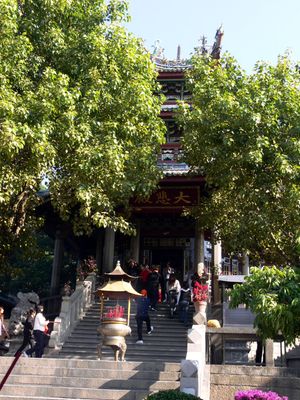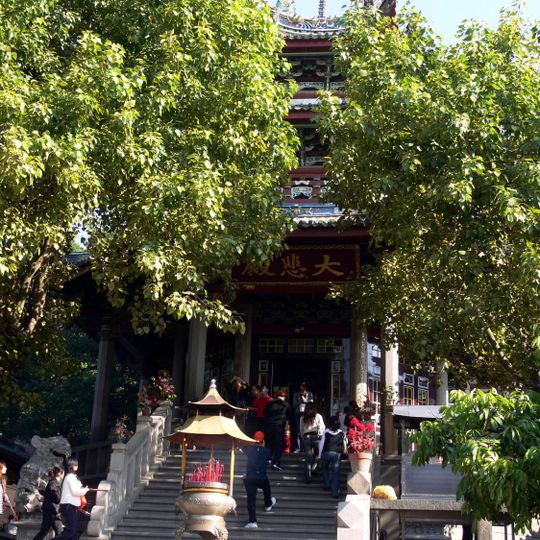
South Putuo Temple, Buddhist temple in Xiamen, China
South Putuo Temple is a Buddhist monastery situated at the base of Mount Wulaofeng, featuring multiple prayer halls and pavilions topped with green glazed roof tiles. The buildings display traditional wooden architecture with intricate carved details and decorative elements throughout the compound.
Founded as Sizhou Temple in the late Tang dynasty, the site was rebuilt as Wujinyan under the monk Wen Cui in the Northern Song, then abandoned in the Yuan. Rebuilt in the Ming as Puzhao Temple and moved to its present location, it was ruined again in the early Qing. In 1684 the Kangxi-era general Shi Lang funded its repair and expansion, adding a Guanyin hall and renaming it South Putuo after Mount Putuo in Zhejiang.
The name refers to Mount Putuo in Zhejiang, the island regarded as Guanyin's abode, since this temple stands south of it and honours the same bodhisattva. In 1924 it became a public monastery open to monks from elsewhere, and the Minnan Buddhist College opened the following year; Hong Yi helped reform monastic education there between 1928 and 1942 and founded the Buddhist Yangzheng Institute in 1934.
Upon arrival, visitors receive complimentary incense sticks and have free access to explore the grounds throughout the day. Wear comfortable shoes since the terrain slopes upward and stone stairs connect the different buildings across the property.
The temple's name comes from its position south of Mount Putuo in Zhejiang, the island regarded as Guanyin's abode; the Guanyin hall here was added when General Shi Lang funded the 1684 rebuilding. The main axis runs from the Hall of Heavenly Kings north through the Mahavira Hall to the octagonal Dabe Hall, rebuilt in 1962 in reinforced concrete.
The community of curious travelers
AroundUs brings together thousands of curated places, local tips, and hidden gems, enriched daily by 93,181 contributors worldwide.