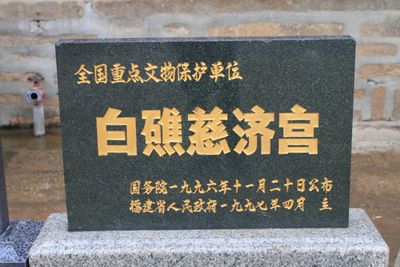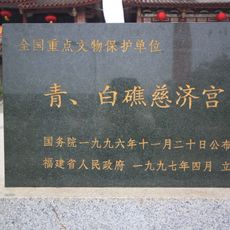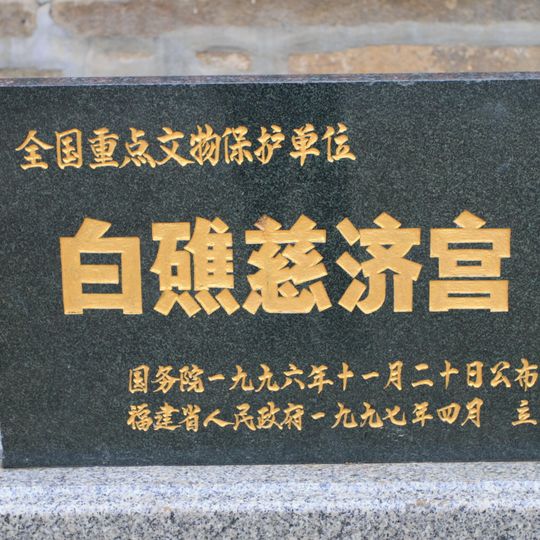
Baijiao Ciji Gong, Temple complex in Longhai District, Fujian Province, China
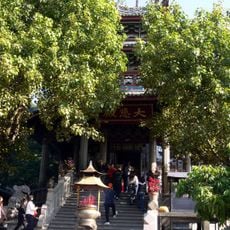
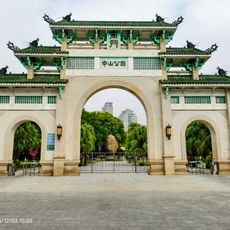
Baijiao Ciji Gong faces southwest and is built on a northeast-southwest axis as a five-door imperial-style complex. Along its central axis stand a gate tower, offering platform, main hall and rear hall, four sections in all, covering more than 5,000 square metres. The central gate bears a plaque inscribed "Ciji Ancestral Palace" by calligrapher Qi Gong.
A shrine to healer Wu Tao was built here after his death; in 1151 official Yan Shilu obtained imperial approval for a temple. In 1166 the court granted the name Ciji and in 1241 raised it to a palace. The front hall was destroyed during the early Qing coastal evacuation; repairs in 1799 and 1809 were partial, and a larger restoration followed in 1810 with support from admiral Wang Delu. Worshippers from Xuejia, Taiwan, donated the front hall's six dragon pillars in 1816.
This temple serves as a primary worship center for Baosheng, a deity deeply rooted in Fujian's religious traditions. Visitors come to pay respects and observe ritual practices that have been maintained through generations in this region.
The temple faces southwest and is entered through a five-bay gatehouse on its central axis, followed by the offering platform, main hall and rear hall across four courtyards. The site covers more than 5,000 square metres, so allow time to walk the whole axis. The gate plaque reading "Ciji Ancestral Palace" was written by calligrapher Qi Gong.
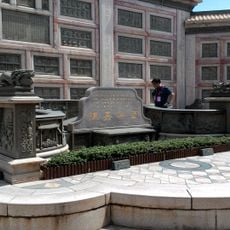
In the main hall stands a stone lion whose right paw bears a seal reading "Ya". According to local tradition, the Yongle Emperor gave it in 1419 after Wu Tao cured Empress Wen. Worshippers call it the "Guomu Shi", the Empress Mother's lion.
The community of curious travelers
AroundUs brings together thousands of curated places, local tips, and hidden gems, enriched daily by 93,904 contributors worldwide.