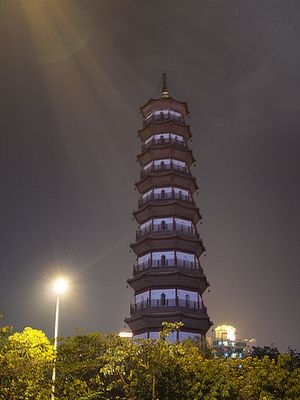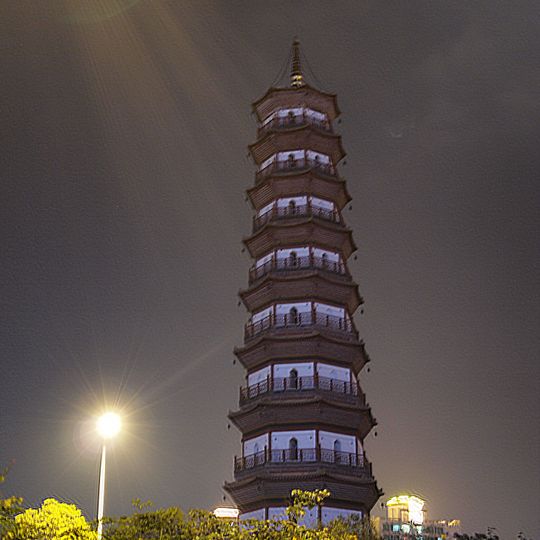
Chigang Pagoda, Chinese pagoda in Haizhu District, Guangzhou, China.
Chigang Pagoda is a Ming-dynasty pavilion-style brick pagoda on a red sandstone hill in Haizhu District, Guangzhou. It has an octagonal plan, nine exterior storeys and seventeen internal levels, and stands 48.9 metres tall. Its base is built of red sandstone blocks, 5.5 metres on each side and one metre high, and figures of foreign men are carved at the corners.
Chigang Pagoda was built from 1619, when Wang Mingxuan initiated construction during the Wanli reign; work halted halfway for lack of funds and was completed under Li Daiwen in the Tianqi era. It was raised on a red sandstone hill together with the Pazhou and Lotus pagodas to bring good fortune to Guangzhou. It was listed as a Guangzhou protected cultural relic in 1989 and a Guangdong provincial one in 2022.
The four stone figures at the base have Western facial features, reflecting the early contact between Chinese and European building traditions in Guangzhou. This detail is rare in structures of this period and makes this pagoda a tangible example of cross-cultural exchange.
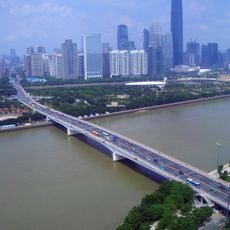
The pagoda stands on a red sandstone hill in the Xinhu community of Chigang Subdistrict, Haizhu District, close to Canton Tower. It can be reached by metro: Chigang Pagoda station on Line 12 and Canton Tower station on Line 3. The pagoda is not open to the public, so it can only be viewed from outside.
The pagoda is part of a planned trio with Pazhou Pagoda and Lotus Pagoda, arranged following Feng Shui principles to shape the city's fortune. The three towers were conceived together as a group, not as separate buildings, which is rare for structures of this type.
The community of curious travelers
AroundUs brings together thousands of curated places, local tips, and hidden gems, enriched daily by 94,358 contributors worldwide.