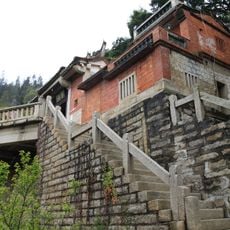
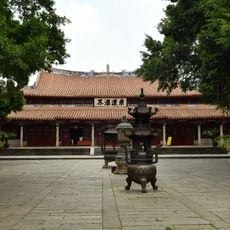
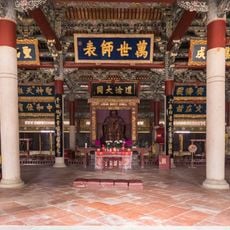
Ding Family Ancestral Hall, Chendai, Ancestral hall in Chendai, Jinjiang, China.
The Ding Family Ancestral Hall in Chendai covers 1,359 square metres and is laid out in the shape of the character 回, with the main hall at the centre and gate, rear halls and side galleries around it. The main hall is three bays wide and five deep, on a mixed post-and-beam timber frame. Its facade has two pale stone columns carved with vertical Chinese characters, red double doors and a curved orange-tiled ridge with sculpted corner figures.
The Ding ancestors, Arabs who settled here in the early Ming, founded the hall during the Yongle reign. It was destroyed by war in 1560 and rebuilt in 1600, during the Wanli reign. In 1985 it became the Chendai Hui History Museum of Jinjiang County.
The Ding trace their descent to Arab ancestors who settled here in the early Ming period, and the hall has housed the Chendai Hui History Museum since 1985. Exhibits inside cover the community's Hui Muslim past. Look for the vertical black inscriptions on the two pale stone columns flanking the red doors.
Visitors can explore the exhibition hall which houses nearly 100 cultural relics and historical documents showcasing the development of the Hui ethnic minority in the region.
The compound's plan forms the character 回, a square within a square: the main hall sits at the centre, ringed by the entrance hall, rear hall and side corridors. The Ding trace their descent to Arab ancestors who settled here in the early Ming; the hall was rebuilt in 1600 after being destroyed by war in 1560.
The community of curious travelers
AroundUs brings together thousands of curated places, local tips, and hidden gems, enriched daily by 93,292 contributors worldwide.