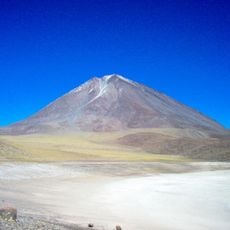
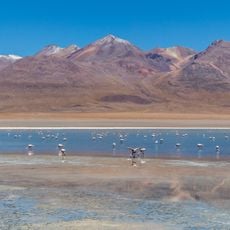
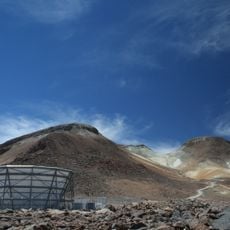
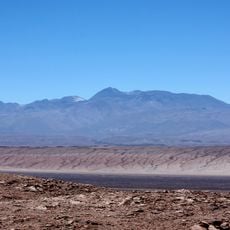
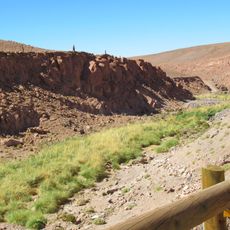
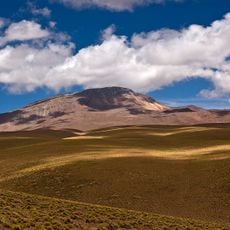
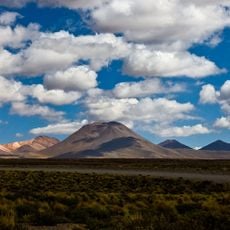
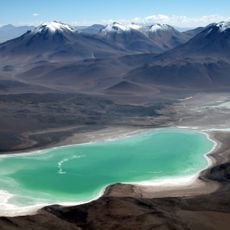
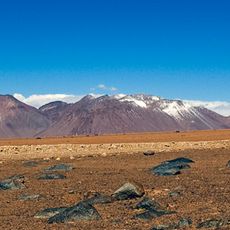
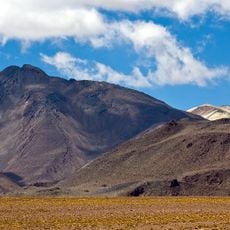
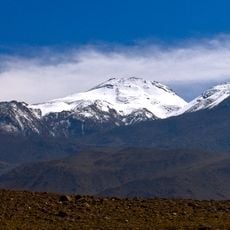
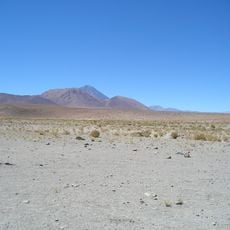
Laguna Verde, Salt lake near Licancabur volcano, Sur Lípez Province, Bolivia.
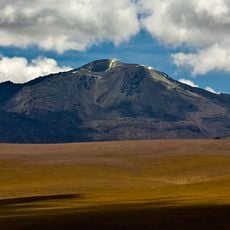
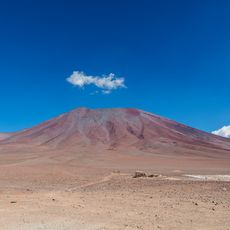
Laguna Verde is a salt lake in Sur Lípez Province, Potosí Department, at 4,310 metres elevation near the Chilean border and below Licancabur volcano. A narrow causeway divides it into two parts. Its colour ranges from turquoise to dark emerald due to suspended arsenic, magnesium, calcium carbonate and lead, shifting with wind disturbance of sediments.
During the Last Glacial Maximum the lake stood at least 45 metres higher and merged with neighbouring Laguna Blanca; former highstands left 30 major and 12 minor shorelines, and a maximum level was reached 13,240 years before present. The two lakes are now joined only by a single channel. Stromatolites covering over 100 square kilometres grew around 20,000 to 10,000 years ago and are inactive today.
The name Laguna Verde is simply Spanish for "green lake", while the Quechua name Q'umirqucha carries the same meaning. Visitors reach the lake on tours through the Eduardo Avaroa Andean Fauna National Reserve, often continuing to the neighbouring Laguna Blanca, which is connected to it by a single channel but differs in colour and chemistry. The lake is one of Bolivia's most important tourism targets.
The lake sits at the southwestern tip of the Eduardo Avaroa reserve, at the foot of the Licancabur volcano, and a narrow causeway divides it in two. Air temperatures swing from 10 to −30 °C and UV radiation is 40% higher than at sea level, so sun protection matters. Winds stir the sediments and shift the water from turquoise to dark emerald.
Stromatolites at Laguna Verde cover over 100 square kilometres, though they are inactive today and are thought to have grown between 20,000 and 10,000 years ago. Smaller structures and microbial mats formed by cyanobacteria still occur in the lake, and the bacterium Chromohalobacter sarecensis was first discovered here.
The community of curious travelers
AroundUs brings together thousands of curated places, local tips, and hidden gems, enriched daily by 92,713 contributors worldwide.