Haasgat, Fossil-bearing cave in Gauteng, South Africa
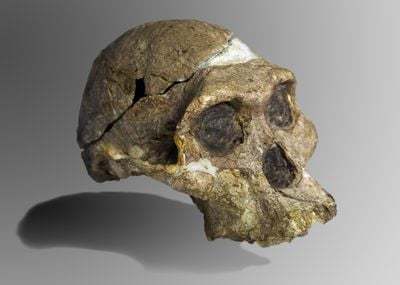
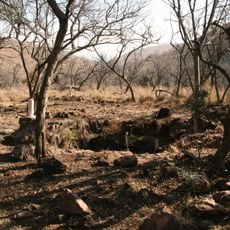
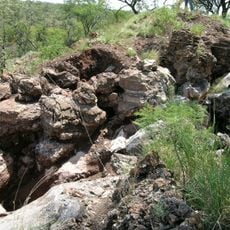
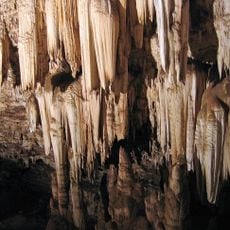
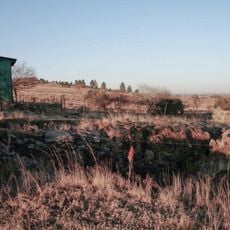
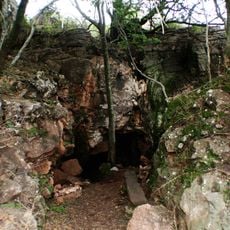
Haasgat is a fossil-bearing cave system on the western slope of a narrow north-south valley in Gauteng, about 20 km northeast of Sterkfontein and Swartkrans. Early 20th-century lime mining removed the original entrance but followed the cave's contours, so a roughly 100 m tunnel keeps its original roof and walls, with remnant bands of calcified fossil sediment. The partial hominin cranium from the site is brown and ochre, with a pale grey band across the upper front and a large dark hollow mid-face.
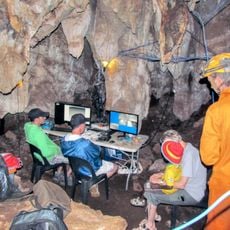
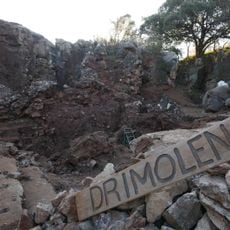
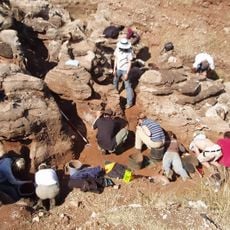
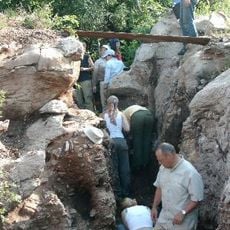
Haasgat was long known to Kalkheuvel West residents, who named it after a red rock hare. Martini and Keyser first mapped the cave system in 1987. Andre Keyser sampled the miners' calcified sediment dumps in the late 1980s, yielding a fossil assemblage described in several publications; the site was then abandoned until an international team resumed work in 2010.
Residents of the Kalkheuvel West area knew the cave long before scientists did and named it Haasgat, Afrikaans for "hare hole", after a red rock hare living there. The name is the main local trace of the site, since the cave sits on private land and cannot be visited.
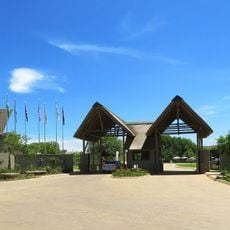
Haasgat lies on private land in the Kalkheuvel West area of Gauteng and is not accessible to the public, so no guided tours or visitor facilities exist. The roughly 100 m tunnel and the ex situ miner's dumps are worked only by the international research team that resumed excavation in 2010. Access requires the landowners' permission.
The miners who quarried Haasgat for lime followed the cave's original contours so closely that the roof and walls survived, and bands of fossil-bearing calcified sediment remain along the roughly 100 m tunnel. Excavations since 2010 have recovered a partial upper hominin molar, attributed to Australopithecus or archaic Homo but not Paranthropus.
The community of curious travelers
AroundUs brings together thousands of curated places, local tips, and hidden gems, enriched daily by 92,825 contributors worldwide.