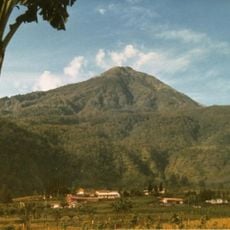
Cetho, Hindu temple on Mount Lawu, Indonesia
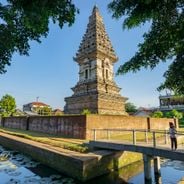
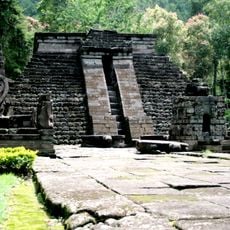
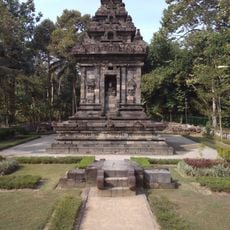
Cetho is a Hindu temple on the western slope of Mount Lawu, at 1,495 m, on the border of Central and East Java. Since its late-1970s renovation it has nine stepped terraces, not eleven, entered through a grand split gate flanked by guardian statues. A broad stone stairway with several flights rises between low walls toward tiered dark roofs, with a small thatched pavilion on a stone platform to the left and red-flowering shrubs along the steps.
The complex was built in the 15th century under King Brawijaya V during the late Majapahit period. It belongs to the last Hindu constructions on Java before Islam became the dominant religion.
Cetho means "clear" in Javanese, named after Dusun Cetho because from the hamlet one can see plainly in every direction: Karanganyar and Solo with Mount Merbabu, Merapi and Sumbing to the north, green hills east and west, and the ridges of Mount Lawu's children to the south. The wooden pendapa flanking the entrance to the upper levels still serve as venues for religious ceremonies, and the site is used by Hindu pilgrims and followers of Kejawen for worship and meditation.
The access road runs through steep mountain roads past villages and tea plantations, about 40 kilometers from Surakarta. The paths between the terraces require sturdy shoes, and mornings offer clearer and cooler air.
On the seventh terrace lies a flat stone arrangement showing a giant turtle, Surya Majapahit and a two-metre phallus with ampallang-type piercing, flanked by carvings of frogs, crabs and mimi. The turtle stands for the creation of the universe and the phallus for human creation; the animals can be read as a suryasengkala giving 1373 Saka, or 1451 AD.
The community of curious travelers
AroundUs brings together thousands of curated places, local tips, and hidden gems, enriched daily by 93,196 contributors worldwide.