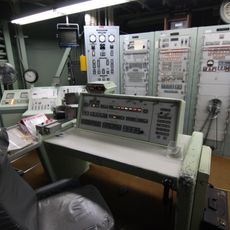
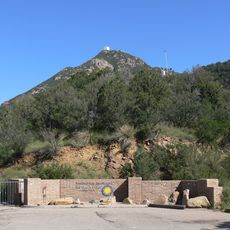
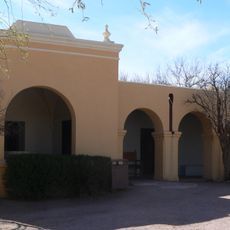
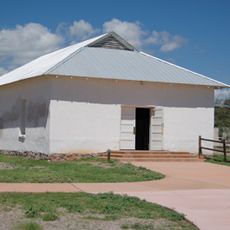
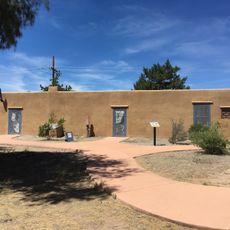
Infrared Optical Telescope Array, Optical interferometer at Fred Lawrence Whipple Observatory, Mount Hopkins, Arizona, US.
The Infrared Optical Telescope Array was an observatory facility on Mount Hopkins that used multiple 45-centimeter telescopes working together to observe celestial objects in the infrared spectrum. These telescopes functioned as an interferometer, combining their data to produce images with much higher resolution than any single instrument could achieve.
IOTA began with a 1988 agreement among five institutions: the Smithsonian Astrophysical Observatory, Harvard University, the University of Massachusetts Amherst, the University of Wyoming and MIT/Lincoln Laboratory. Construction on site ran through 1993 and 1994, with first fringes in December 1993. A third telescope came online in 2000, enabling closure-phase observations and aperture synthesis imaging. The array was decommissioned and disassembled in summer 2006 for lack of funding.
IOTA was a joint project of five institutions: the Smithsonian Astrophysical Observatory, Harvard University, the University of Massachusetts Amherst, the University of Wyoming and MIT/Lincoln Laboratory. The 1988 agreement behind it aimed at fundamental astrophysical observations and at testing techniques for a larger array. The site was decommissioned and disassembled in summer 2006 for lack of funding.
IOTA stood at the Fred Lawrence Whipple Observatory on Mount Hopkins, Arizona, at roughly 31.69° N, 110.89° W. The array was decommissioned and disassembled in summer 2006 for lack of funding, so no instrument remains to visit; the site is reached via the observatory access road south of Tucson.
IOTA's third telescope, added in 2000, enabled closure phase observations, which made aperture synthesis imaging possible there for the first time. The array was decommissioned and disassembled in summer 2006 for lack of funding, so nothing remains on Mount Hopkins to visit.
The community of curious travelers
AroundUs brings together thousands of curated places, local tips, and hidden gems, enriched daily by 92,820 contributors worldwide.